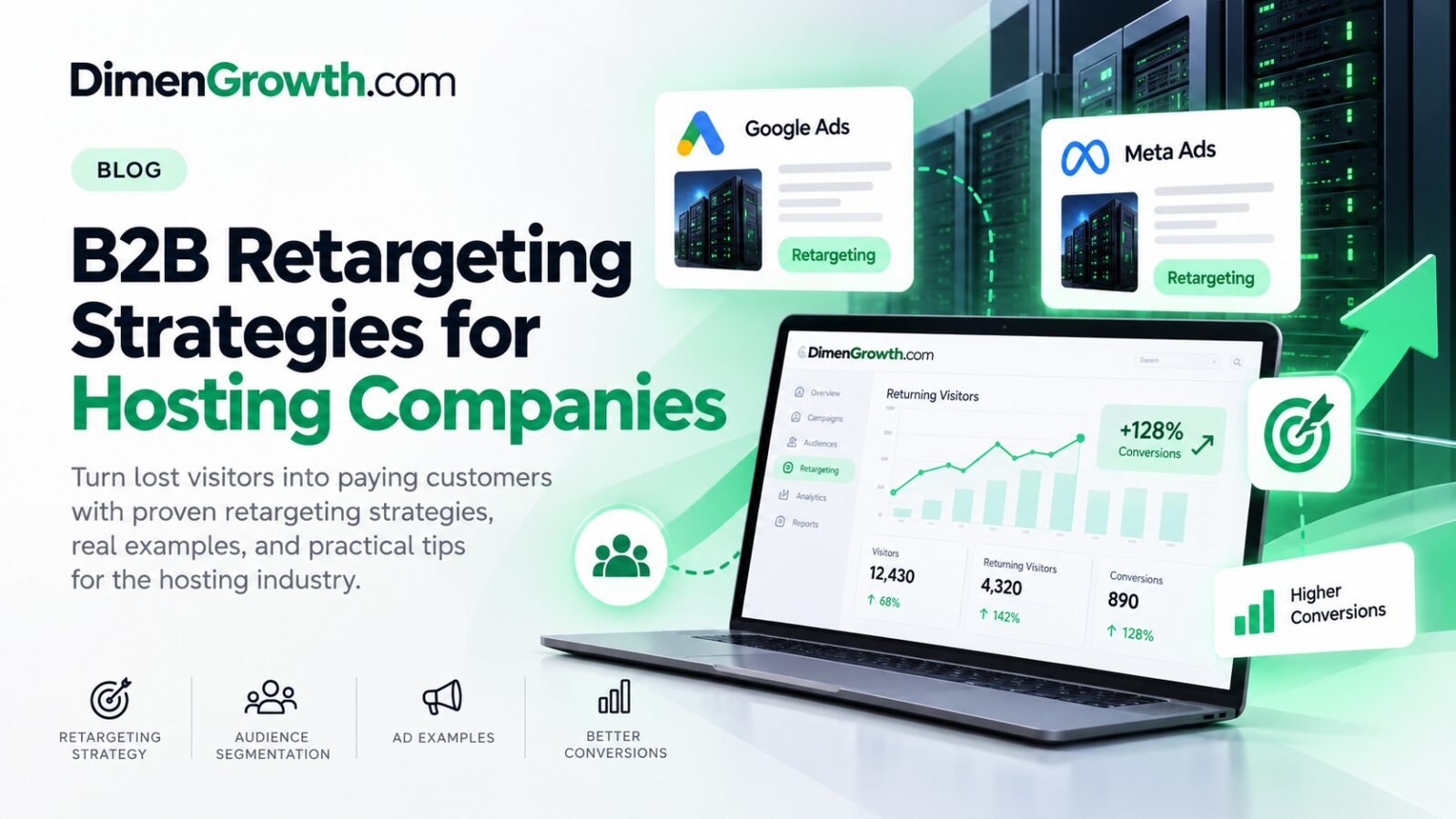
Getting someone to visit your website is one thing. Getting them to become a customer is something else entirely.
For B2B companies, that difference can represent months of work.
A potential customer might discover your business through Google, read two articles, explore your services, and leave without contacting anyone. A week later, they might search for alternatives. Another month passes before they discuss the project with their team.
During that time, your company might never hear from them.
This is where a well planned B2B retargeting strategy becomes valuable.
Instead of treating every website visitor as a lost opportunity, retargeting gives your business another chance to connect with people who have already demonstrated some level of interest.
But successful retargeting involves much more than following visitors around the internet with the same advertisement.
It requires understanding what buyers need, identifying meaningful intent signals, selecting the right advertising platforms, and delivering messages that make sense at each stage of the purchasing process.
For businesses with longer sales cycles, including SaaS providers, technology companies, professional services firms, and hosting providers, this approach can help turn existing marketing attention into qualified sales conversations.
In this guide, Dimen Growth explains how to build a practical B2B retargeting strategy across Google Ads, LinkedIn Ads, Meta Ads, and Reddit Ads, with a focus on qualified leads, sales opportunities, and measurable pipeline growth.
What Is B2B Retargeting?
B2B retargeting is a digital advertising strategy that reconnects businesses with people who have previously interacted with their website, advertisements, content, or other marketing activities.
These interactions might include visiting a service page, watching a product demonstration, reading an industry guide, or opening a lead generation form without submitting it.
Rather than targeting everyone in a broad market, retargeting focuses on audiences that have already shown some familiarity with your business.
The goal of B2B retargeting is to move interested prospects closer to a meaningful business decision.
Consider a company selling cloud infrastructure solutions.
A potential buyer searches for enterprise cloud hosting, visits the provider’s website, reviews its infrastructure capabilities, and leaves.
That visitor may still be researching providers. They might need technical approval, a pricing comparison, or reassurance about service reliability before requesting a proposal.
A retargeting campaign could introduce relevant technical documentation, a migration checklist, or a detailed explanation of the provider’s infrastructure.
The message is relevant because it builds on what the visitor has already explored.
Effective retargeting creates useful continuity between the first interaction and the next step in the buyer’s journey.
What Is the Difference Between Retargeting and Remarketing?
The terms retargeting and remarketing are often used interchangeably.
Retargeting commonly refers to reaching previous visitors or engaged audiences through paid advertisements.
Remarketing is sometimes used more broadly to describe reconnecting with existing prospects through advertising, email, and customer relationship management activities.
For practical campaign planning, both concepts share the same objective: reconnect with people who already know something about your business.
The distinction matters less than how effectively those interactions are coordinated.
Why B2B Retargeting Is Different From B2C Retargeting
Imagine someone browsing an online store for running shoes.
They find a product, compare prices, and might purchase within a few hours.
Now imagine a manufacturing company evaluating enterprise resource planning software.
The operations director wants better reporting. The finance department wants predictable costs. The IT team needs security documentation. Senior management wants evidence that the investment will solve a meaningful business problem.
One advertisement will rarely satisfy all those requirements.
B2B purchasing decisions often involve several stakeholders, internal discussions, technical evaluations, and multiple rounds of approval.
This creates three challenges for retargeting.
1. Interest Does Not Always Mean Purchase Readiness
Someone reading a blog about CRM systems might be learning about the category rather than actively choosing a vendor.
Showing that person an aggressive sales message immediately could be premature.
They may respond better to educational material that helps them understand their options.
2. The Buyer Is Not Always the Decision Maker
A marketing specialist might research advertising agencies, while the final approval comes from a marketing director or business owner.
Your strategy needs to account for different roles within the purchasing process.
3. The Buying Window Can Be Difficult to Predict
A prospect may have a genuine requirement but no approved budget.
Another prospect may suddenly receive approval and need a provider urgently.
Retargeting helps maintain visibility between these moments, provided the communication remains useful rather than repetitive.
For a deeper look at longer buying journeys, explore our guide to LinkedIn Ads funnel strategies for B2B companies with long sales cycles.
Why B2B Companies Should Invest in Retargeting
Many businesses invest heavily in generating traffic while paying relatively little attention to what happens after a visitor leaves.
They spend on search advertising, publish content, run social campaigns, and attend industry events.
Each activity introduces potential buyers to their business.
But without a structured follow up process, much of that initial attention is never developed into a meaningful sales opportunity.
A good retargeting strategy helps address that problem.
Make Better Use of Existing Marketing Traffic
Your business has already invested resources in attracting website visitors.
Retargeting provides another opportunity to engage eligible visitors with relevant messages.
This does not guarantee a conversion, but it creates more opportunities to communicate value before a buying decision is made.
Support Prospects During Research
B2B buyers often revisit a problem several times before requesting a conversation.
A useful advertisement might introduce information they have not yet considered, such as implementation requirements, integration options, or common purchasing mistakes.
Build Familiarity With Your Business
A prospect who encounters your company through several relevant interactions may develop a clearer understanding of its expertise and services.
This is especially useful when your competitors offer similar products or make similar promises.
Improve Coordination Between Marketing and Sales
Retargeting becomes more valuable when campaigns respond to meaningful sales activity.
For example, a prospect who has already requested a proposal should not continue receiving advertisements designed for someone who has never heard of the company.
Their next message should reflect their position in the purchasing process.
The objective is not to generate more impressions.
It is to make marketing more useful to the people sales is trying to reach.
Step 1: Define What Retargeting Should Achieve
Before installing tracking tags or creating advertising audiences, decide what business outcome the campaign should support.
This sounds straightforward, but it is where many campaigns lose direction.
A marketing team might launch retargeting because website traffic is increasing. The audience is available, the advertising platform recommends using it, and the budget can accommodate another campaign.
None of those reasons establishes a meaningful objective.
Start with the questions your sales team actually cares about.
Are enough qualified prospects booking meetings?
Are people visiting important service pages without submitting enquiries?
Are opportunities becoming inactive after the first conversation?
Are existing leads failing to progress because buyers need more information?
Each problem requires a different approach.
Match the Objective to the Buying Stage
For early stage visitors, the objective might be meaningful content engagement.
For prospects comparing options, the objective could be a case study download or product demonstration.
For high intent prospects, the objective may be a consultation request, proposal enquiry, or qualified meeting.
For existing opportunities, the objective might be helping buyers complete their evaluation.
Avoid setting every campaign to maximise form submissions without considering whether those submissions are commercially valuable.
Ten enquiries from businesses that cannot purchase your service may be less valuable than two meetings with companies that match your ideal customer profile.
At Dimen Growth, the emphasis is on connecting paid media activity to qualified pipeline rather than treating lead volume as the final measure of success.
Step 2: Understand Your Ideal Customer Profile
Retargeting audiences are not automatically valuable simply because they contain people who visited your website.
A visitor may be a potential customer, a job applicant, a competitor, a student, or someone researching a topic for unrelated reasons.
Your ideal customer profile helps distinguish commercially relevant audiences from general activity.
Start by defining the businesses most likely to benefit from your offering.
Consider their industry, company size, geographic market, operational challenges, purchasing capacity, and typical decision makers.
Then examine how those characteristics appear in your website behaviour and CRM records.
For example, a company selling enterprise hosting solutions may prioritise visits to dedicated infrastructure, managed VPS, security, and migration pages.
A B2B advertising agency might place greater importance on visitors exploring service capabilities, requesting audits, or reviewing information about campaign management.
Neither company should assume that every visitor to its homepage has the same purchasing intent.
Separate Visitor Behaviour From Buyer Quality
A prospect can display strong interest while still being unsuitable for your offering.
Someone might repeatedly visit a premium service page but have a budget far below your minimum engagement level.
Another visitor may only read one technical page yet represent a company with an urgent purchasing requirement.
Website activity is a useful signal, not a complete picture of buyer quality.
Where possible, combine behavioural information with CRM qualification, sales feedback, and information prospects voluntarily provide.
This creates a more useful foundation for campaign decisions.
Step 3: Build Retargeting Audiences Based on Intent
The biggest mistake in audience building is treating all previous visitors as one group. Not every visitor needs another ad; the B2B email nurture guide offers a consent-based alternative for people who requested continued information.
A person who briefly views your homepage should not necessarily receive the same advertisement as someone who reviewed your pricing and started filling out a contact form.
These interactions suggest different levels of interest.
A practical starting point is to build audiences around four categories.
General Website Visitors
These people visited your website but have not demonstrated a clear product or service preference.
They may be researching a problem, learning about your company, or browsing related information.
Useful retargeting content includes educational articles, industry insights, and explanations of common challenges.
Avoid assuming they are ready to book a sales meeting.
Content Engagers
This audience includes people who have interacted with articles, guides, webinars, videos, or other educational material.
Their interests can help identify which topics matter to them.
For example, someone who reads several articles about improving Google Ads performance might be interested in campaign audits, account structure, or conversion tracking.
A relevant next step could be our guide to Google Ads audit steps for identifying wasted B2B advertising budget.
The important detail is the progression.
Offer content that adds something new rather than repeatedly promoting information the prospect has already consumed.
Service and Product Page Visitors
Visitors who explore specific service pages may have a clearer understanding of their requirements.
Their next advertisement could address questions commonly asked during vendor evaluation.
For a LinkedIn advertising service, this might involve audience targeting, attribution, budget planning, or lead quality.
For a hosting provider, it might involve migration support, reliability, infrastructure requirements, or contract terms.
High Intent Prospects
These people have taken actions that may indicate stronger purchase consideration.
Examples include visiting a pricing page, beginning an enquiry form, requesting a demonstration, or reviewing several related services.
High intent audiences may benefit from more direct offers.
A consultation, technical assessment, account review, or tailored proposal can make sense when the offer addresses the next decision the buyer needs to make.
However, engagement alone does not confirm that a prospect has purchasing authority or an approved budget.
Step 4: Use Audience Recency to Improve Relevance
When someone interacted with your business can be almost as important as what they viewed.
A visitor who explored your pricing yesterday may be considering providers right now.
Someone who read an article four months ago may have a completely different level of interest.
Audience recency helps account for that distinction.
Consider the following example framework.
| Audience window | Possible interpretation | Suggested approach |
|---|---|---|
| 1 to 7 days | Recent interest | Continue the conversation with relevant information |
| 8 to 30 days | Ongoing evaluation | Address questions, objections, and alternatives |
| 31 to 90 days | Extended consideration | Introduce case studies and useful educational content |
| 91 to 180 days | Older engagement | Reconnect only when the message remains relevant |
These windows are planning examples, not universal recommendations. Actual availability and membership limits vary by advertising platform and audience type.
A business selling a relatively simple service may need shorter windows.
A company selling enterprise software or infrastructure contracts might have reason to nurture prospects over a longer period.
The right duration depends on how customers actually buy.
Avoid Building Audiences That Are Too Small
Excessive segmentation can create another problem.
A company might divide visitors by service, location, device, job function, behaviour, and recency until every audience contains too few eligible people to serve advertisements reliably.
This is particularly relevant for niche B2B markets.
Start with meaningful audience groups. Add detail when traffic volume and performance evidence justify it.
Step 5: Choose the Right B2B Retargeting Platforms
Not every advertising platform plays the same role.
The strongest approach depends on where your customers spend time, how they research providers, and what actions you want them to take next.
For many B2B companies, Google, LinkedIn, and Meta provide useful starting points. Reddit may add value for specific technical or research oriented audiences.
The goal is not to advertise on every platform.
It is to select channels that contribute something meaningful to the purchasing journey.
Google Ads Retargeting for Active Research
Google Ads can help reconnect with previous visitors across eligible advertising inventory, including Search, YouTube, and Display, depending on campaign settings and audience eligibility.
Its strength is the connection between audience familiarity and ongoing research behaviour.
Consider someone who previously visited your website while researching managed cloud hosting.
Later, they search for related solutions or watch videos about cloud migration.
Where supported by the campaign type and privacy settings, audience information can help shape how your advertising reaches these users.
For B2B businesses, Google Ads retargeting is particularly useful when prospects continue researching a problem after their first visit.
Relevant advertisements should answer the next question rather than simply repeat the initial offer.
You can learn more about how Dimen Growth approaches Google Ads for B2B lead generation.
LinkedIn Ads Retargeting for Professional Audiences
LinkedIn is especially relevant when your sales process depends on reaching specific professional roles, industries, or companies.
Its Matched Audiences capabilities can support retargeting based on eligible website visits and several forms of advertising engagement.
This creates opportunities to reconnect with professionals who have already interacted with your business.
Imagine a business selling cybersecurity services.
A visitor reads an article about protecting corporate infrastructure. Later, they interact with a technical guide promoted through LinkedIn.
A subsequent campaign could introduce a security assessment or a relevant implementation case study.
The messaging progresses from understanding a problem toward evaluating a solution.
LinkedIn can also support account focused advertising when the company needs to reach several people involved in a purchasing decision.
However, audience eligibility, size, and privacy restrictions must be considered before planning highly specific segments.
Our LinkedIn Ads for B2B service focuses on connecting professional audience targeting with qualified sales opportunities.
Meta Ads Retargeting for Continued Awareness and Education
Meta is often overlooked in B2B advertising because Facebook and Instagram are commonly associated with consumer marketing.
But business decision makers also spend time on these platforms.
Meta can support retargeting through eligible website activity, advertising engagement, and customer audiences.
Its role is often strongest when the creative is designed to maintain familiarity and communicate useful information.
For example, a business software company could promote a short video demonstrating how its product solves a common reporting problem.
A professional services firm could introduce a practical checklist relevant to a challenge prospects previously researched.
The important consideration is message quality.
Someone browsing Instagram is not necessarily prepared to complete a lengthy enterprise purchasing enquiry.
An advertisement that communicates one relevant idea clearly may be more appropriate than a complicated sales pitch.
Explore how Meta Ads for B2B can complement search and LinkedIn campaigns.
Reddit Ads Retargeting for Technical and Research Driven Buyers
Reddit can be useful for businesses whose customers actively discuss technical problems, software tools, and purchasing considerations in relevant communities.
It offers eligible website and engagement retargeting options, alongside other audience targeting capabilities.
For hosting companies, developer tools, SaaS platforms, and specialist technology services, this can create an additional opportunity to reach people with relevant interests.
However, Reddit users often respond poorly to vague promotional language.
An advertisement that explains a specific technical problem or offers genuinely useful information is generally a more sensible starting point than exaggerated promises.
The tone should reflect the audience.
A developer researching server performance is unlikely to be impressed by generic statements about revolutionary technology.
They may respond better to a clear explanation of architecture, migration considerations, or measurable performance requirements.
Discover our approach to Reddit Ads for B2B companies.
Step 6: Set Up Reliable Tracking Before Launching Campaigns
Retargeting depends on having usable audience and conversion signals.
If your tracking setup is incomplete, campaigns may struggle to build audiences, exclude converted visitors, or identify which advertising activity contributes to useful business outcomes.
Before launching, review the basic measurement infrastructure.
For Google Ads, this may include the Google tag and appropriate conversion events.
For LinkedIn, website retargeting commonly uses the Insight Tag.
Meta uses the Meta Pixel and can use the Conversions API.
Reddit supports the Reddit Pixel and Conversions API.
The exact implementation depends on your website, advertising accounts, consent requirements, and measurement architecture.
Track Actions That Indicate Business Value
Page views alone are not enough.
Where relevant and permitted, consider measuring events such as completed enquiry forms, demonstration requests, consultation bookings, and qualified lead submissions.
A prospect visiting a confirmation page after a successful enquiry can be a useful conversion signal.
But the setup must avoid counting refreshes, duplicate submissions, or unrelated actions as new conversions.
Test the Complete Journey
Check that the correct events fire when users complete the intended action.
Confirm that conversion events are not triggered simply because someone clicks a button without successfully submitting a form.
Review how leads enter your CRM and whether the relevant campaign information is preserved.
Respect Privacy and Consent Requirements
Retargeting must operate within applicable privacy laws, platform policies, and user consent choices.
Businesses operating in the UAE or targeting international audiences should review the requirements relevant to their actual data collection and advertising activities.
Do not assume that installing a tracking tag automatically gives you permission to build every possible audience.
Customer data uploads, tracking permissions, retention periods, and audience exclusions should be handled carefully.
Reliable advertising measurement starts with responsible data practices.
Step 7: Create a Retargeting Message for Each Buying Stage
Retargeting fails when businesses confuse familiarity with readiness to purchase.
Just because someone recognises your company does not mean they want a sales conversation today.
The message should respond to what the prospect likely needs next.
Awareness Stage: Help Buyers Understand the Problem
At this stage, prospects may recognise a challenge without knowing the best way to solve it.
Your advertisements should clarify the issue and provide useful perspective.
For a company selling marketing services, an appropriate topic might be why increasing advertising spend does not automatically generate more qualified leads.
A relevant advertisement could say:
“Getting more leads is easy to measure. Knowing which leads turn into revenue is the harder part.”
The supporting content could explain attribution, lead qualification, or the difference between form submissions and pipeline.
Consideration Stage: Help Buyers Compare Options
Once prospects understand the problem, their questions change.
They want to know how different solutions work, what implementation involves, and which approach fits their circumstances.
This is a good opportunity to introduce comparisons, practical frameworks, demonstrations, or customer examples.
A hosting company might explain the differences between managed VPS and dedicated hosting.
A marketing agency might compare campaign management approaches for companies with different sales cycles.
Decision Stage: Reduce Uncertainty
Buyers approaching a decision often need reassurance.
They may want to understand the delivery process, service scope, reporting, technical compatibility, or expected responsibilities.
Advertising can help address these concerns through clear explanations and relevant proof.
Avoid making unsupported performance promises.
If you have a genuine customer success story, explain the circumstances and results accurately. If you do not have permission to publish customer outcomes, focus on your process and expertise instead.
Existing Opportunity Stage: Support the Sales Conversation
Once a prospect is speaking with sales, advertising should not behave as though the relationship has just started.
Coordinate messages with the questions currently being discussed.
A prospect evaluating an enterprise hosting migration might benefit from an implementation checklist.
A marketing director comparing advertising partners might appreciate a framework for assessing attribution and reporting quality.
This approach supports the buying process without unnecessarily repeating the sales pitch.
Step 8: Build Creative That Gives Prospects a Reason to Return
One of the most common retargeting problems is creative repetition.
A prospect visits a website once and then sees the same company logo and sales message repeatedly.
The advertisements create visibility, but little new value.
Effective creative should answer a simple question.
What will the prospect learn or understand from seeing this advertisement that they did not know before?
That answer provides a useful starting point for the campaign.
Use Different Creative Angles
A practical retargeting programme can test several creative approaches.
Problem focused creative: Explain a challenge the audience is likely facing.
Educational creative: Share a framework, checklist, or practical insight.
Proof focused creative: Demonstrate your process or show an authorised customer example.
Objection focused creative: Address concerns related to cost, implementation, integration, or service quality.
Action focused creative: Invite qualified prospects to take a relevant next step.
These angles can be introduced based on audience behaviour and the campaign objective.
Write Like a Business That Understands Its Customers
Avoid advertisements filled with vague statements about unlocking growth, transforming success, or revolutionising an industry.
Those phrases are easy to write but rarely explain why a business should care.
Specific language is more useful.
Instead of saying, “Transform your advertising performance today,” explain the problem:
“Your Google Ads campaigns are generating enquiries. Which ones actually become sales opportunities?”
That message introduces a real business question.
It can lead naturally to an audit, article, or consultation.
For additional inspiration, see our article on Google Ads mistakes that hurt B2B campaign performance.
Step 9: Match Every Advertisement to the Right Landing Page
Even a well targeted advertisement can fail when the landing page does not fulfil its promise.
Imagine an advertisement offering a detailed guide to improving LinkedIn lead quality.
A prospect clicks because that is the problem they want to solve.
Instead of finding the guide, they arrive on a general agency homepage with several unrelated services.
The visitor now needs to search for the information they expected.
Many will simply leave.
Keep the Message Consistent
The landing page should clearly address the subject introduced in the advertisement.
If the advertisement promises a checklist, the page should provide that checklist.
If it offers an account review, the page should explain what the review includes.
If it promotes a product demonstration, visitors should understand what they will see and how to request it.
Remove Unnecessary Friction
Review the page from the perspective of someone who is still evaluating your company.
Can they immediately understand the offer?
Does the page explain who the service is suitable for?
Are important questions answered before the enquiry form?
Is the form asking for information you actually need?
Does the page work properly on mobile devices?
Support Multiple Levels of Readiness
Not every visitor is ready to request a consultation.
A useful landing page may provide a primary conversion opportunity while also helping visitors who need further information.
Related articles, service explanations, and relevant examples can help prospects continue their research.
For businesses improving their website experience, Dimen Growth’s B2B website design service focuses on creating websites that support meaningful conversions.
Step 10: Connect Retargeting With Your CRM and Sales Process
Advertising platforms can show which campaigns generated clicks and reported conversions.
They cannot independently tell you everything that happens during the sales process.
A form submission might result in an unqualified enquiry.
Another submission might become a valuable opportunity that takes several months to close.
If your marketing decisions only consider the initial submission, those two outcomes may appear equally successful.
CRM integration helps close that gap.
Understand What Happens After Lead Generation
At a minimum, your reporting should distinguish between new enquiries, qualified leads, sales meetings, opportunities, and customers where the data is available.
The exact definitions should be agreed upon with your sales team.
For example, a qualified lead might need to match your target industry, meet a minimum service requirement, and demonstrate a realistic purchasing timeline.
That definition should be consistent enough to support useful comparisons.
Use Sales Feedback to Improve Audiences
Suppose a campaign regularly attracts businesses that are too small for your service.
Marketing can review targeting, messaging, and qualification requirements.
If prospects frequently misunderstand the offer, the landing page may need clearer explanations.
If high quality enquiries become inactive after a sales call, the business may need more useful follow up material.
These insights can inform retargeting content and audience exclusions.
Keep Audiences Updated
Where platform policies, permission requirements, and technical integrations allow, CRM information can help maintain relevant audience groups.
Customers may need to be excluded from acquisition campaigns.
Existing opportunities may require different messages.
Closed opportunities should not automatically receive the same advertising indefinitely.
The purpose is to make communication more relevant, not to collect or use unnecessary personal information.
Step 11: Decide How Much Budget to Allocate to Retargeting
There is no universal retargeting budget that works for every B2B company.
An enterprise SaaS provider with substantial website traffic has different requirements from a local consultancy receiving a few hundred visits per month.
The appropriate budget depends on eligible audience size, advertising costs, campaign objectives, and the value of a qualified opportunity.
Start With Audience Capacity
Before assigning a fixed monthly amount, examine how many eligible users your campaigns can realistically reach.
A small audience may not support significant spending without creating excessive repetition.
A larger audience spread across several products may justify more detailed campaigns.
Consider the Role of Each Channel
Google may be useful for reconnecting during active research.
LinkedIn can support professional audience targeting.
Meta may help maintain awareness and introduce educational messages.
Reddit may provide a relevant environment for technical audiences.
Your budget should reflect the role each channel can realistically perform.
Use a Planning Example, Not an Arbitrary Rule
Suppose a B2B company has AED 20,000 available for monthly advertising.
It might initially reserve AED 3,000 for a retargeting test and use the remaining budget for activities that introduce new prospects to its business.
That is an illustrative starting point, not a recommended percentage for every advertiser.
The allocation should change when audience size, campaign results, and sales outcomes provide enough evidence.
Do not increase spending simply because the platform can spend more.
Increase investment when it supports a commercially sensible objective.
For broader channel planning, read 7 B2B paid media channels ranked by ROI for UAE companies in 2026.
Step 12: Measure Pipeline Impact, Not Just Advertising Activity
Retargeting reports can look impressive without proving much about business growth.
High click rates, inexpensive traffic, and large impression counts may indicate engagement.
They do not necessarily show that advertising influenced qualified opportunities.
A more useful measurement framework connects platform activity with business results.
Understand the Key Metrics
Click through rate helps indicate whether the creative attracts attention from the audience receiving it.
Conversion rate shows how often the measured action occurs after a qualifying interaction.
Cost per lead indicates how much advertising spend is associated with each reported lead.
Cost per qualified lead provides a more useful view when qualification standards are consistent.
Cost per sales opportunity helps connect marketing expenditure with meaningful pipeline creation.
Pipeline value estimates the potential commercial value of opportunities associated with marketing activity.
Customer acquisition cost compares the relevant acquisition expenditure with customers gained.
Each metric answers a different question.
A campaign should not be judged exclusively by the number that looks most favourable.
Be Careful With Attribution
A prospect may see a LinkedIn advertisement, visit your website through Google, receive an email, and eventually book a meeting directly.
Several systems may claim credit for parts of that journey.
Simply adding their reported conversions together can overstate the number of unique outcomes.
Review attribution settings and compare advertising data with CRM records.
Where practical, use controlled experiments or holdout groups to understand whether retargeting generates additional outcomes beyond those that would have occurred anyway.
Understand the Difference Between Revenue and Influence
A campaign may assist an opportunity without being the only reason it converted.
That influence can still be valuable.
But it should not automatically be described as revenue generated entirely by the campaign.
Clear reporting builds confidence and supports better budget decisions.
Step 13: Build a Retargeting Strategy for Different B2B Industries
The same basic principles apply across industries, but the content and buying signals should change.
Here are three examples.
Example 1: A SaaS Company Selling Business Software
A software provider receives traffic from people researching reporting and workflow automation.
Early visitors might engage with educational content explaining common operational problems.
Visitors who explore product capabilities could receive advertisements featuring practical demonstrations.
Prospects who request pricing may need information about implementation, onboarding, and integrations.
The CRM should help distinguish general interest from qualified opportunities.
The campaign objective is not simply to increase demonstration bookings.
It is to increase useful conversations with companies that have the right requirements.
Example 2: A Hosting and VPS Company
A hosting provider attracts visitors through technical articles, search advertising, and service pages.
Someone reading an article about server performance may be researching a technical issue.
A visitor comparing managed VPS solutions may be closer to choosing a provider.
These audiences require different content.
The first might benefit from practical guidance about infrastructure sizing or performance monitoring.
The second may want information about migration, uptime commitments, security, and support.
A prospect who has already requested a technical consultation may need reassurance about the implementation process.
Hosting companies can connect these activities with their broader digital marketing services for hosting and VPS businesses.
For search driven lead generation, our Google Ads service for hosting and VPS companies addresses the importance of reaching buyers with relevant infrastructure requirements.
Example 3: A B2B Services Company in Dubai
A consulting company generates traffic through Google Ads and LinkedIn.
Some visitors review general industry advice, while others explore service pages and contact information.
Educational retargeting can support early stage research.
LinkedIn campaigns may help maintain visibility with relevant professional audiences.
More direct consultation offers can be introduced when behaviour suggests stronger interest.
A local business should also consider its actual service geography.
A company serving only UAE organisations may not benefit from allocating significant budget to visitors outside its commercial market.
Similarly, a business serving the wider GCC should avoid assuming that every regional market has identical purchasing conditions.
The appropriate strategy follows the sales model.
Step 14: Create a Practical 90 Day B2B Retargeting Plan
You do not need dozens of campaigns to begin.
A smaller programme with reliable tracking, relevant audiences, and clear objectives can provide a better foundation than a complicated setup that nobody can manage properly.
The following plan provides a starting structure.
Days 1 to 30: Build the Foundation
Review your existing website traffic and advertising activity.
Identify the pages and actions most relevant to potential customers.
Confirm which conversion events are already measured and whether the data is reliable.
Define your ideal customer profile with input from sales.
Create an initial set of audiences based on meaningful website behaviour or eligible advertising engagement.
Review consent requirements, tracking implementations, and exclusions.
Develop a small number of creative concepts addressing different levels of purchase readiness.
At this stage, the main objective is to establish a system that can be measured.
Do not rush to judge performance before audiences have enough activity to support useful conclusions.
Days 31 to 60: Launch and Learn
Introduce campaigns on the channels that best fit your audience and available data.
Start with messages that correspond to identifiable visitor interests.
For example, people who explored a specific service can receive relevant information about that service.
Monitor audience delivery, impressions, engagement, landing page behaviour, and conversion tracking.
Check whether the same people are receiving advertisements too frequently.
Review early lead quality with sales instead of relying exclusively on platform reporting.
If a campaign produces enquiries, investigate what those prospects actually want.
If an audience produces little activity, assess whether it is large enough or whether the message is appropriate.
Avoid reacting to every small daily fluctuation.
Look for patterns that justify a change.
Days 61 to 90: Improve the Campaign Structure
By this stage, you may have enough information to identify useful signals, although smaller B2B programmes can require longer observation periods.
Review which audience groups demonstrate meaningful engagement.
Compare creative approaches.
Evaluate whether prospects are reaching relevant pages and completing valuable actions.
Introduce additional creative only where there is a clear reason to test it.
Consider excluding audiences that have completed the intended conversion or no longer meet the campaign objective.
Review how leads are progressing through the sales process.
Where measurement allows, compare the results of retargeting activity with a credible baseline or controlled test.
The next budget decision should reflect what the evidence supports.
The purpose of the first 90 days is to establish a reliable learning process, not to promise a particular number of customers.
Step 15: Avoid These Common B2B Retargeting Mistakes
Some retargeting mistakes are technical. Others come from misunderstanding how B2B buyers make decisions.
Both can waste budget.
Mistake 1: Showing Everyone the Same Advertisement
A general website visitor and a prospect who has requested pricing do not need identical messages.
Group audiences according to meaningful behaviour and purchasing stage.
Mistake 2: Asking for a Meeting Too Early
A visitor who has only read an introductory article may not be ready for a sales conversation.
Provide helpful information before introducing a more demanding offer.
Mistake 3: Continuing to Advertise to Converted Prospects
A person who has already booked a consultation should not keep receiving advertisements asking them to book that same consultation.
Review conversion based exclusions and CRM coordination.
Mistake 4: Using Weak Tracking as the Basis for Budget Decisions
If conversion events are duplicated or lead quality is not recorded, the reports may encourage poor decisions.
Fix measurement problems before increasing investment.
Mistake 5: Ignoring Creative Fatigue
Repeatedly showing the same advertisement can reduce its usefulness.
Monitor delivery frequency and engagement patterns.
Refresh content when evidence suggests the audience needs a different message.
Mistake 6: Overcomplicating Audience Segmentation
Too many small audiences can make campaign delivery and reporting difficult.
Start with clear categories and add detail when it contributes to better decisions.
Mistake 7: Treating Cheap Leads as Successful Leads
Low cost enquiries can look attractive until sales discovers that most prospects are unsuitable.
Include qualification and opportunity progression in performance reviews.
Mistake 8: Running Retargeting Without Generating New Demand
Retargeting cannot build a sustainable programme entirely on its own.
It depends on eligible audience activity created by other marketing and business interactions.
A broader growth strategy might include B2B SEO, search advertising, content marketing, professional audience campaigns, and referrals.
These activities introduce new prospects while retargeting supports relevant continued engagement.
Mistake 9: Assuming Every Conversion Was Caused by Retargeting
Some prospects would have returned and converted without another advertisement.
Use appropriate attribution analysis and, when feasible, experiments to distinguish reported credit from additional business impact.
Mistake 10: Forgetting the Human Side of the Buying Process
Retargeting is not only about audience rules and advertising technology.
It involves people who need information, reassurance, and time to make decisions.
The best message often comes from understanding the questions prospects are already asking your sales team.
How Retargeting Works With SEO and Content Marketing
Retargeting is often discussed as a paid advertising technique, but its effectiveness can depend heavily on the quality of your organic content.
Imagine a potential buyer finding your website through an article about reducing cloud infrastructure costs.
That article answers a genuine question.
The visitor may not need a vendor immediately, but the interaction provides an opportunity to introduce further relevant material later, where tracking and audience eligibility permit.
The content attracts interest. Retargeting can help continue the conversation.
This is one reason B2B SEO and paid media work well together when they address the same business objectives.
SEO helps businesses become discoverable through useful pages and articles.
Paid media provides additional opportunities to reach eligible audiences.
Retargeting connects certain previous interactions with relevant follow up messages.
Make Content Useful Beyond Search Rankings
A strong article should answer real questions, explain a topic clearly, and provide practical information.
These qualities also make content easier to reference in AI powered search experiences.
Clear explanations, specific examples, descriptive headings, and concise answers help readers and automated systems understand the information.
However, being mentioned in an AI generated answer is not guaranteed by formatting alone.
Content quality, originality, relevance, authority, and discoverability remain important.
For Dimen Growth, the most useful approach is to create content that serves a genuine buyer question and then connect that content with relevant services.
That relationship supports organic visibility, paid advertising, and a more useful website experience.
How to Know When Your Retargeting Strategy Needs Improvement
Retargeting campaigns rarely operate perfectly from the beginning.
The important thing is knowing what to investigate when performance changes.
If impressions are limited, check audience eligibility, size, targeting restrictions, and campaign delivery settings.
If advertisements receive attention but generate little useful website activity, review the message and landing page.
If visitors complete forms but sales rejects the enquiries, investigate qualification and offer alignment.
If campaigns appear to generate conversions but pipeline does not improve, examine measurement accuracy, attribution, and the quality of the opportunities.
If frequency increases without corresponding business outcomes, consider reducing spend, refreshing creative, or changing audience rules.
And if the campaign reports strong results while overall sales remain unchanged, question whether retargeting is genuinely producing additional demand.
Different symptoms require different responses.
Changing bids will not fix poor messaging.
New creative will not repair broken conversion tracking.
More budget will not solve an offer that attracts the wrong audience.
Successful optimisation begins by identifying the actual constraint.
Frequently Asked Questions About B2B Retargeting
What is the best retargeting platform for B2B companies?
There is no single best platform for every B2B company.
Google Ads may be useful when buyers repeatedly research solutions through search and video. LinkedIn can support campaigns aimed at professional audiences and relevant organisations. Meta can help maintain familiarity through engaging educational content. Reddit may be suitable for certain technical and research oriented markets.
The best choice depends on your customers, campaign objective, eligible audience size, and available budget.
Does B2B retargeting actually work?
B2B retargeting can support qualified lead generation and sales opportunities when campaigns reach relevant audiences with useful messages.
However, campaign effectiveness depends on targeting, tracking, creative quality, audience size, and the purchasing process.
Reported advertising conversions should also be evaluated against actual CRM outcomes and, where possible, incremental business impact.
How long should B2B retargeting campaigns run?
The appropriate campaign duration depends on how long customers take to make purchasing decisions.
A company selling straightforward services may need shorter audience windows than an enterprise software provider with a lengthy evaluation process.
Review audience engagement, sales cycle length, frequency, and privacy requirements before deciding how long prospects should remain eligible.
What is the difference between B2B retargeting and account based marketing?
B2B retargeting focuses on reconnecting with eligible people who have previously interacted with a company.
Account based marketing focuses on selected target organisations and the stakeholders involved in their purchasing decisions.
The two approaches can work together.
For example, a company may use account targeting to reach strategically important organisations and retarget eligible individuals who engage with its content.
Can you retarget B2B website visitors on LinkedIn?
Yes. LinkedIn provides website retargeting through its Matched Audiences capabilities.
Advertisers need an appropriate tracking setup and an eligible audience that meets the platform’s requirements.
Campaign delivery also depends on audience size, applicable privacy choices, and targeting restrictions.
How much should a B2B company spend on retargeting?
The appropriate amount depends on audience size, advertising costs, deal value, and campaign objectives.
A small audience may not justify a large budget.
A larger business with substantial qualified traffic may be able to support several audience groups and platforms.
Start with a budget that allows useful testing without creating unnecessary advertising repetition.
What are the most effective B2B retargeting ads?
Effective advertisements address a relevant question or obstacle in the purchasing process.
Educational content may be appropriate for early stage audiences.
Case studies, demonstrations, and service comparisons can help prospects evaluating solutions.
Consultations and proposals may suit prospects who have demonstrated stronger buying intent.
The best message reflects what the audience needs next.
Should B2B businesses use retargeting and email marketing together?
Yes, when the communication is relevant and follows applicable consent and data protection requirements.
Email can support direct communication with known contacts, while advertising can provide additional eligible touchpoints.
Coordination matters.
A prospect should not receive conflicting offers or repetitive messages simply because different teams manage advertising and email separately.
How do you measure B2B retargeting ROI?
Start by identifying relevant campaign costs and the business outcomes associated with the activity.
Track qualified leads, sales opportunities, customer acquisition, and resulting revenue where reliable data is available.
Use consistent attribution rules and avoid double counting results across platforms.
Where possible, run experiments to estimate how much additional business the campaigns produce.
Can small B2B companies use retargeting?
Yes, although limited audience size can make some approaches impractical.
Smaller businesses should begin with reliable tracking, meaningful audience groups, and a narrow campaign objective.
They may benefit from focusing on one suitable platform rather than splitting a limited budget across several channels.
Audience eligibility and useful conversion volume should guide the decision.
Final Thoughts: Retargeting Should Help Buyers Move Forward
Most B2B customers do not make important purchasing decisions after a single advertisement or website visit.
They research, compare, ask questions, discuss alternatives, and reconsider priorities.
That process creates opportunities for businesses willing to communicate with patience and relevance.
A successful B2B retargeting strategy does not attempt to pressure every visitor into becoming a customer immediately.
It recognises the difference between curiosity, consideration, and genuine purchasing intent.
It uses audience data responsibly, selects channels based on buyer behaviour, and provides information that helps prospects make better decisions.
Most importantly, it connects advertising activity with qualified leads, sales opportunities, and real business outcomes.
At Dimen Growth, we help B2B companies connect paid media, search visibility, audience targeting, and conversion improvement into a more coordinated growth strategy.
Whether your business needs to improve Google Ads performance, build a stronger LinkedIn advertising programme, or reconnect with valuable prospects across several platforms, the starting point is the same.
Understand who your customers are, what matters to them, and what they need before taking the next step.
Want to turn more of your existing website traffic into qualified sales conversations?
Talk to the Dimen Growth team about building a paid media strategy focused on qualified pipeline rather than clicks alone.
If video is part of your retargeting mix, see our YouTube Ads guide for B2B lead generation for creative and measurement ideas.