Google Ads is the highest-intent acquisition channel available to B2B companies. When a decision-maker searches for a solution to a problem your product solves, they are raising their hand. The channel works because it captures demand that already exists rather than creating it from scratch.
But google ads mistakes b2b companies make consistently undermine that intent advantage. Campaigns that should be generating qualified pipeline instead burn budget on irrelevant searches, send high-intent clicks to poorly optimised pages, and measure the wrong outcomes entirely. These are the 10 most damaging mistakes in B2B Google Ads management, and exactly how to fix each one.
| Key Takeaways Broad match keywords without a robust negative keyword list is the single most expensive B2B Google Ads mistakeSending all paid traffic to a homepage rather than a dedicated landing page typically cuts conversion rates in halfWithout proper conversion tracking, every optimisation decision is based on incomplete or wrong dataThe Search Terms Report is checked by fewer than 20 percent of B2B advertisers, despite being one of the most valuable optimisation tools availableSmart Campaigns and Performance Max require active oversight to prevent B2B budget being wasted on irrelevant placementsMeasuring click volume instead of pipeline value is what keeps B2B Google Ads campaigns permanently underoptimised |
Why Google Ads Mistakes Hit B2B Harder Than B2C
In B2C advertising, a wasted click costs a few pence or cents and is absorbed by volume. In B2B, a wasted click on a competitive keyword can cost anywhere from AED 25 to AED 400 depending on the industry and keyword. With typical B2B Google Ads CPCs in the range of AED 50 to AED 200, a campaign running with structural errors burns through budget at a rate that produces no return and no data.
The B2B context also means that conversion events are more complex, buyer journeys are longer, and the connection between a click and a closed deal is harder to trace. These complications make proper campaign structure and measurement even more critical than in direct-response B2C advertising. Every one of the mistakes below is more damaging in a B2B context than it would be in a consumer campaign.
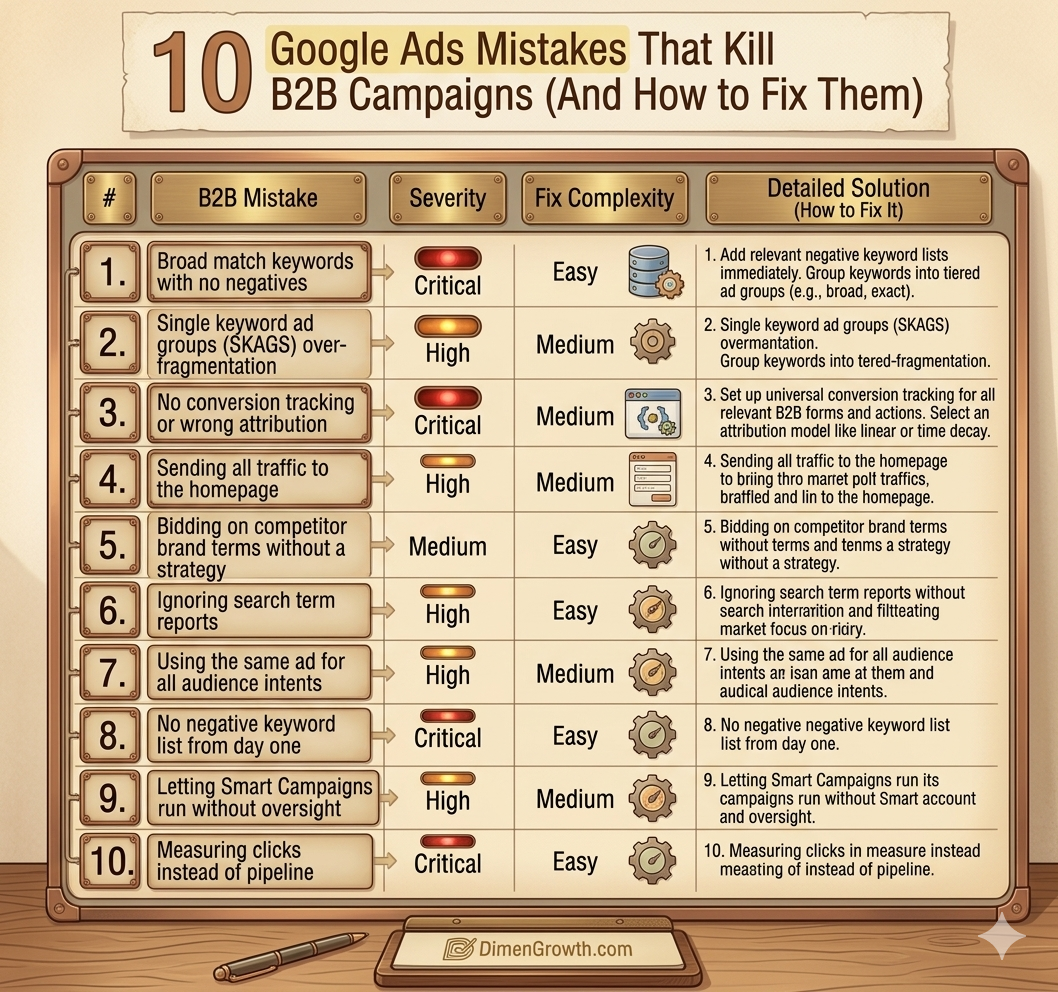
| # | Mistake | Impact on B2B | Difficulty to Fix |
| 1 | Broad match keywords with no negatives | Critical | Easy |
| 2 | Single keyword ad groups (SKAGs) over-fragmentation | High | Medium |
| 3 | No conversion tracking or wrong attribution | Critical | Medium |
| 4 | Sending all traffic to the homepage | High | Medium |
| 5 | Bidding on competitor brand terms without a strategy | Medium | Easy |
| 6 | Ignoring search term reports | High | Easy |
| 7 | Using the same ad for all audience intents | High | Medium |
| 8 | No negative keyword list from day one | Critical | Easy |
| 9 | Letting Smart Campaigns run without oversight | High | Medium |
| 10 | Measuring clicks instead of pipeline | Critical | Easy |
The 10 Google Ads Mistakes That Kill B2B Campaigns
Mistake 1: Using Broad Match Keywords Without a Robust Negative List
Broad match is Google’s default keyword match type and it is the most dangerous setting for B2B advertisers operating with limited budgets. Broad match allows Google to show your ads for any search query it considers thematically related to your keyword. For a B2B company targeting “marketing automation software,” broad match can trigger your ad for searches like “marketing jobs,” “automation engineer salary,” or “free email tools” — none of which have any commercial intent for your product.
The fix is not to avoid broad match entirely. Used correctly with a comprehensive negative keyword list, broad match can discover high-value query variations you would not have found with exact match alone. The fix is to never run broad match without simultaneously building and maintaining a negative keyword list that excludes every irrelevant search category. Start with phrase match or exact match for new campaigns. Add broad match only after you have at least 30 days of search term data to build your negative list from.
- Immediate action: Review your Search Terms Report today and add every irrelevant query as a negative keyword
- Negative keyword categories for B2B: job-related terms, free/DIY modifiers, consumer terms, competitor product names you are not targeting, geographic terms outside your service area
- Match type recommendation: Start new campaigns with phrase match. Graduate to broad match with strong negatives after 60 days of data.
- Review cadence: Search Terms Report review every week for the first 90 days of a new campaign
Mistake 2: Over-Fragmented Campaign Structure
Single Keyword Ad Groups (SKAGs) were a best practice in Google Ads for many years. The logic was sound: one keyword per ad group means maximum control over messaging relevance. But Google’s machine learning, match type changes, and the introduction of Responsive Search Ads have made extreme fragmentation counterproductive for most B2B campaigns.
When a campaign has 400 ad groups with one or two keywords each, the data is spread too thin for Google’s bidding algorithm to learn efficiently. Each ad group needs a minimum volume of conversions before Smart Bidding can optimise effectively. In B2B campaigns with low conversion volumes, over-fragmentation means the algorithm never accumulates enough data to function, and manual bidding on 400 ad groups is practically impossible to manage with precision.
The fix is to consolidate to tightly themed ad groups with three to eight closely related keywords per group. This concentrates conversion data, accelerates algorithmic learning, and reduces management overhead without sacrificing the relevance that made SKAGs appealing. For most B2B campaigns, 10 to 30 well-structured ad groups outperform 200 to 400 over-fragmented ones.
- Target ad group structure: 3 to 8 closely related keywords per ad group, grouped by intent and theme
- Minimum conversion volume for Smart Bidding: 30 conversions per month per campaign (50 or more is optimal)
- Consolidation approach: Merge ad groups with similar keywords and below-threshold conversion volumes
- Exception: Keep high-volume, high-value keywords isolated if they have sufficient individual conversion data
Mistake 3: No Conversion Tracking or Wrong Attribution Model
This is the most critical mistake on this list because every other optimisation decision depends on it. If your conversion tracking is not set up correctly, or if you are tracking the wrong events, every bid adjustment, keyword decision, and budget allocation you make is based on false data. You are optimising toward a metric that does not represent your actual business outcome.
Common B2B conversion tracking errors include: tracking page views instead of form submissions, tracking form submissions that include spam and bot completions, not tracking phone calls, not connecting Google Ads to CRM data to understand lead quality, and using last-click attribution for long buying cycles where multiple touchpoints contribute to conversion.
The fix requires three components: accurate conversion event tracking (form submission confirmation page, phone call duration threshold, chat initiation), conversion quality filtering (exclude low-quality leads through CRM integration or lead scoring), and attribution model selection appropriate for your sales cycle length (data-driven attribution or linear attribution rather than last-click for complex B2B journeys).
- Required conversion events: Form submission (thank-you page URL), phone call (30 seconds or more minimum duration), chat initiation
- CRM integration: Import offline conversion data from your CRM to tie closed revenue back to Google Ads clicks
- Attribution model: Use data-driven attribution if you have sufficient conversion volume. Use linear attribution for lower-volume B2B campaigns with long sales cycles.
- Validation step: Cross-check Google Ads conversion data against your CRM monthly to identify tracking discrepancies
Mistake 4: Sending All Traffic to the Homepage
A company homepage is designed to serve multiple audiences: prospects, customers, partners, job seekers, and investors. It contains links to dozens of pages and competes for attention across multiple value propositions simultaneously. Sending paid traffic from a specific, high-intent search query to this multi-purpose page is a guaranteed conversion rate suppressor.
A decision-maker who searches “b2b marketing automation software for mid-size companies” and clicks your ad is looking for immediate confirmation that they have found the right solution. A homepage that begins with a generic welcome message and navigation to ten different sections tells them nothing and sends them back to Google within seconds.
The fix is a dedicated landing page for every distinct campaign and audience segment. The landing page should match the search intent exactly: repeat the keyword or its near-equivalent in the headline, present a single, clear value proposition relevant to the search context, and contain one CTA. Dedicated landing pages for B2B Google Ads campaigns consistently deliver two to four times higher conversion rates than homepage destinations.
- Landing page requirements: Single CTA, headline matching search intent, social proof relevant to the searcher’s context, mobile-optimised layout
- Page speed: B2B landing pages that load in under 2 seconds convert at significantly higher rates than slow pages. Test with Google PageSpeed Insights.
- Personalisation: Use keyword insertion or dynamic content to match the landing page headline to the specific search query
- Test priority: Run a homepage versus dedicated landing page A/B test if you are not yet convinced of the impact
Mistake 5: Bidding on Competitor Brand Terms Without a Clear Strategy
Competitor keyword campaigns, where you bid on a competitor’s brand name to appear when someone searches for them, can be a powerful B2B tactic. They can also be a significant budget drain with minimal return if executed without strategy. The mistake is not running competitor campaigns. The mistake is running them without a compelling reason for the searcher to click your ad instead of the competitor’s own result.
Someone searching for a specific competitor by name already has intent toward that brand. Showing them a generic ad about your product is unlikely to interrupt that intent effectively. The winning approach for competitor keyword campaigns is to offer a specific, direct comparison or a compelling alternative framing: “Switching from [Competitor]? See how we compare” or “[Competitor] alternative: 40 percent lower cost, same outcome.” The ad must address the comparison intent, not ignore it.
Before running competitor campaigns, also confirm that your target keywords are not restricted by trademark policy, and that your landing page is specifically designed to convert comparison-intent searchers with a direct side-by-side or migration narrative.
- Ad copy requirement: Address the comparison intent directly in the headline
- Landing page requirement: A dedicated comparison page with honest, specific differentiation
- CPC expectation: Competitor brand keywords are often more expensive due to lower Quality Scores for non-brand advertisers
- Strategic question: Would the budget deliver more pipeline applied to high-intent solution keywords instead?
Mistake 6: Not Reviewing the Search Terms Report Regularly
The Google Ads Search Terms Report shows you the actual queries that triggered your ads, which is often dramatically different from the keywords you thought you were targeting. This is one of the most valuable reports in the entire platform and one of the least frequently reviewed by B2B advertisers.
A B2B company targeting “enterprise resource planning software” with broad or phrase match may discover through the Search Terms Report that their ads are triggering for “ERP student project,” “ERP vs spreadsheet difference,” and “what is ERP system” — informational queries with zero commercial intent that are consuming budget and generating zero qualified leads.
The Search Terms Report review should happen weekly for new campaigns and bi-weekly for established campaigns. Every review should produce at least five to ten new negative keywords added to the account. Over 90 days, a consistently maintained negative keyword list from Search Terms Report analysis can reduce wasted spend by 20 to 40 percent without changing a single bid or budget setting.
- Review frequency: Weekly for campaigns under 90 days old. Bi-weekly for established campaigns.
- Output per review: Minimum 5 new negative keywords added per session
- Filter to use: Sort by impressions or cost to identify the highest-spend irrelevant queries first
- Tool: Use Google Ads Editor for bulk negative keyword additions across multiple campaigns
Mistake 7: Using the Same Ad Creative for All Search Intents
B2B searchers at different stages of the buying cycle use fundamentally different search queries. Someone searching “what is marketing automation” is at the beginning of their education. Someone searching “best marketing automation software for B2B” is evaluating options. Someone searching “HubSpot alternative pricing” is ready to make a decision. Each of these queries represents a different intent, and serving all three the same ad creative is a missed opportunity at every stage.
The fix is to segment your campaigns by search intent and create ad creative specifically designed for each intent stage. Awareness-intent queries get educational, benefit-focused ads. Consideration-intent queries get comparison and proof-point ads. Decision-intent queries get offer-forward ads with specific CTAs like “Book a demo” or “Get pricing.” Each intent stage should also have a corresponding landing page designed for that stage’s conversion goal.
- Intent categories: Awareness (what is, how to, guide), Consideration (best, top, comparison, alternative), Decision (pricing, demo, buy, trial)
- Ad copy differentiation: Awareness ads educate. Consideration ads differentiate. Decision ads convert.
- Landing page alignment: Each intent stage needs a landing page matched to its conversion expectation
- Bid strategy: Allocate higher bids to decision-intent keywords where conversion probability is highest
Mistake 8: No Negative Keyword List Built From Day One
This is closely related to Mistake 1 but deserves its own entry because it is a setup issue, not an optimisation issue. Most B2B Google Ads campaigns launch with zero negative keywords in place. The first weeks of a new campaign then generate a range of irrelevant clicks that waste budget and corrupt the initial performance data.
A foundational negative keyword list should be built before a campaign goes live, using a combination of industry knowledge, competitor analysis, and keyword research tool data. For B2B campaigns, this list should include at minimum: job and career-related terms, consumer and B2C modifiers, free and DIY qualifiers, educational and academic terms, and geographic terms outside your service area.
Building a 200 to 400 term negative keyword list before campaign launch is a one-time investment that can save thousands of AED in wasted spend during the critical first 30 days when the algorithm is still learning and budget efficiency is at its lowest.
- Pre-launch negative list categories: Jobs, careers, salary, free, cheap, DIY, template, student, university, research, non-target geographic terms
- List size target: 200 to 400 negatives at launch. Expand weekly using Search Terms Report data.
- Negative match type: Use phrase match negatives for most exclusions. Use exact match for terms that might appear as sub-strings of valid queries.
- Shared lists: Build a shared negative keyword list in Google Ads that applies across all campaigns in the account
Mistake 9: Letting Smart Campaigns and Performance Max Run Without Oversight
Google’s automated campaign types, particularly Performance Max, are powerful tools when managed correctly. They become budget traps when set up and left to run without monitoring. Performance Max, which serves ads across Search, Display, YouTube, Gmail, and Discover simultaneously, is particularly problematic for B2B advertisers because the Display, YouTube, and Discover placements frequently generate low-quality traffic with zero commercial intent.
The mistake is treating automation as a set-and-forget solution. Smart campaigns and Performance Max require active management: placement exclusion lists to prevent irrelevant network serving, asset group review to ensure only high-quality creative combinations are being tested, search insight reports to identify what queries are driving conversions, and audience signal inputs that guide the algorithm toward your actual ICP rather than a broad proxy.
For B2B advertisers with limited budgets, a well-managed Search-only campaign with manual or enhanced CPC bidding often outperforms Performance Max for the first 90 days of a campaign, because the data quality and control are higher during the learning phase.
- Performance Max management requirements: Weekly asset group review, placement exclusion list maintenance, search category insight monitoring
- B2B recommendation: Run Search-only campaigns for the first 60 to 90 days. Add Performance Max only after establishing baseline CPL and conversion volume.
- Placement exclusions: Build exclusion lists for mobile app placements, parked domains, and content categories irrelevant to B2B buyers
- Audience signals: Provide customer list, website visitor, and similar audience signals to guide Performance Max learning toward your ICP
Mistake 10: Measuring Click Volume Instead of Pipeline Value
This is the measurement mistake that keeps B2B Google Ads campaigns permanently underoptimised. When the primary success metric is clicks, impressions, or even raw conversion volume without quality filtering, campaign decisions are made to maximise metrics that are only loosely correlated with pipeline and revenue.
A B2B campaign generating 200 leads per month at AED 80 CPL looks far better than one generating 40 leads at AED 400 CPL in a standard performance report. But if the first campaign’s leads are 90 percent unqualified and the second campaign’s leads are 85 percent sales-qualified, the revenue math is completely inverted. The expensive campaign is actually more efficient by the metric that matters.
The fix requires closing the loop between Google Ads and CRM data. Import offline conversions (qualified leads, opportunities, closed deals) back into Google Ads from your CRM using Google’s offline conversion import or via a third-party integration. Once pipeline value is visible in your Google Ads account, you can optimise bidding, keywords, and ad creative toward the outcomes that generate revenue rather than the outcomes that generate volume.
- Required integration: Google Ads offline conversion import connected to CRM opportunity and deal stage data
- Primary B2B metric: SQL (sales-qualified lead) CPL and pipeline value per campaign, not raw lead volume
- Bidding implication: Once offline conversion data is imported, use Target CPA or Target ROAS bidding against pipeline value metrics rather than raw form submissions
- Reporting: Build a monthly report that shows Google Ads spend, pipeline generated, and closed revenue attributed to Google Ads to give leadership the full ROI picture
The B2B Google Ads Audit Checklist
Run through this checklist against your current campaigns. Each item corresponds directly to one of the 10 mistakes above.
- Is your negative keyword list active and updated in the last 30 days?
- Do you have more than 50 ad groups? If so, review for consolidation opportunities.
- Are your conversion events tracking form submissions, not just page views?
- Is paid traffic being sent to dedicated landing pages, not the homepage?
- Do competitor keyword campaigns have a comparison-specific landing page?
- Has the Search Terms Report been reviewed in the last 14 days?
- Does each intent stage (awareness, consideration, decision) have separate ad creative?
- Does the account have a shared negative keyword list with at least 200 terms?
- Is Performance Max or Smart Campaign placement performance being reviewed weekly?
- Is CRM data connected to Google Ads for offline conversion measurement?
If you answered no to four or more of these, your campaigns have significant untapped optimisation potential. Our Google Ads team at Dimen Growth audits B2B campaigns and rebuilds them for pipeline performance, not just traffic volume.
Frequently Asked Questions
What is the most common Google Ads mistake for B2B companies?
The most expensive and most common mistake is using broad match keywords without a comprehensive negative keyword list. This combination causes B2B budgets to be consumed by irrelevant consumer, job-related, and informational searches that will never convert to qualified leads. The fix is straightforward but requires consistent maintenance: weekly Search Terms Report review and ongoing negative keyword expansion.
How much should a B2B company spend on Google Ads to see results?
A meaningful B2B Google Ads test requires a minimum of AED 8,000 to 15,000 per month and at least 60 days to generate enough data for informed optimisation decisions. Below this level, conversion volumes are too low for Smart Bidding to function effectively, and the data is insufficient to distinguish campaign structure issues from keyword selection issues. For competitive B2B verticals, effective budgets typically range from AED 20,000 to AED 80,000 per month.
Is Google Ads or LinkedIn Ads better for B2B lead generation?
They serve different purposes and are most effective when used together. Google Ads captures existing demand from buyers actively searching for a solution. LinkedIn Ads creates demand by reaching buyers who are not yet searching but match your ICP. For B2B companies with strong search volume around their solution category, Google Ads typically delivers lower CPL for direct conversion campaigns. LinkedIn Ads is more effective for building brand awareness and reaching decision-makers who do not yet have a defined search intent.
How long does it take for B2B Google Ads campaigns to become profitable?
Most B2B Google Ads campaigns require 60 to 90 days before they are operating at their potential efficiency. The first 30 days generate learning data. Days 30 to 60 allow for structural fixes based on that data. Days 60 to 90 see Smart Bidding algorithms accumulate sufficient conversion data to optimise effectively. Campaigns evaluated at 30 days are almost always underperforming their potential, and decisions made on 30-day data often lead to structural changes that reset the learning period.
Should B2B companies use automated or manual bidding in Google Ads?
For campaigns with fewer than 30 conversions per month, manual CPC or Enhanced CPC bidding typically outperforms Smart Bidding because automated strategies lack sufficient data to optimise effectively at low conversion volumes. Once campaigns consistently generate 30 or more conversions per month, transitioning to Target CPA or Target ROAS Smart Bidding usually improves efficiency by 15 to 30 percent over manual management, provided conversion tracking is accurate.
Fix These Mistakes Before Your Next Campaign Goes Live
The google ads mistakes b2b companies make are not obscure or complex. They are structural and measurement errors that accumulate silently while budget drains away. The fix for most of them takes hours, not weeks: build your negative keyword list, set up proper conversion tracking, create dedicated landing pages, review your Search Terms Report, and connect your CRM.
Most B2B companies running Google Ads with these mistakes in place could improve their pipeline output by 30 to 60 percent without increasing budget. The opportunity cost is enormous. The fixes are practical.
If you want an expert audit of your B2B Google Ads account to identify exactly where budget is being lost and what to fix first, our team at Dimen Growth runs Google Ads campaigns for B2B companies focused on pipeline and revenue, not traffic metrics.
Ready to fix your Google Ads campaigns? Book a free B2B Google Ads audit with our team.
Related reading: LinkedIn Ads Strategy for B2B | B2B Ads Agency Dubai
Sources: Google Ads Help Centre | WordStream Google Ads Benchmarks