Wasted spend on irrelevant search queries is the single most common cause of underperforming B2B Google Ads campaigns in the UAE. Every time your ad appears for a job seeker, a student researching a topic for an assignment, or someone looking for a free tool, you pay the same CPC as you would for a C-suite buyer with active purchase intent. In the UAE’s competitive Google Ads environment, where CPCs for B2B keywords regularly run between AED 40 and AED 300, that waste compounds fast.
A comprehensive negative keywords b2b google ads UAE list is the highest-ROI account optimisation a B2B advertiser can implement. It costs nothing to add, requires no budget change, and immediately redirects spend away from zero-intent queries toward the buyers you actually want to reach. For context on the full list of structural mistakes that drain B2B Google Ads budgets, see our detailed breakdown of Google Ads mistakes that kill B2B campaigns.
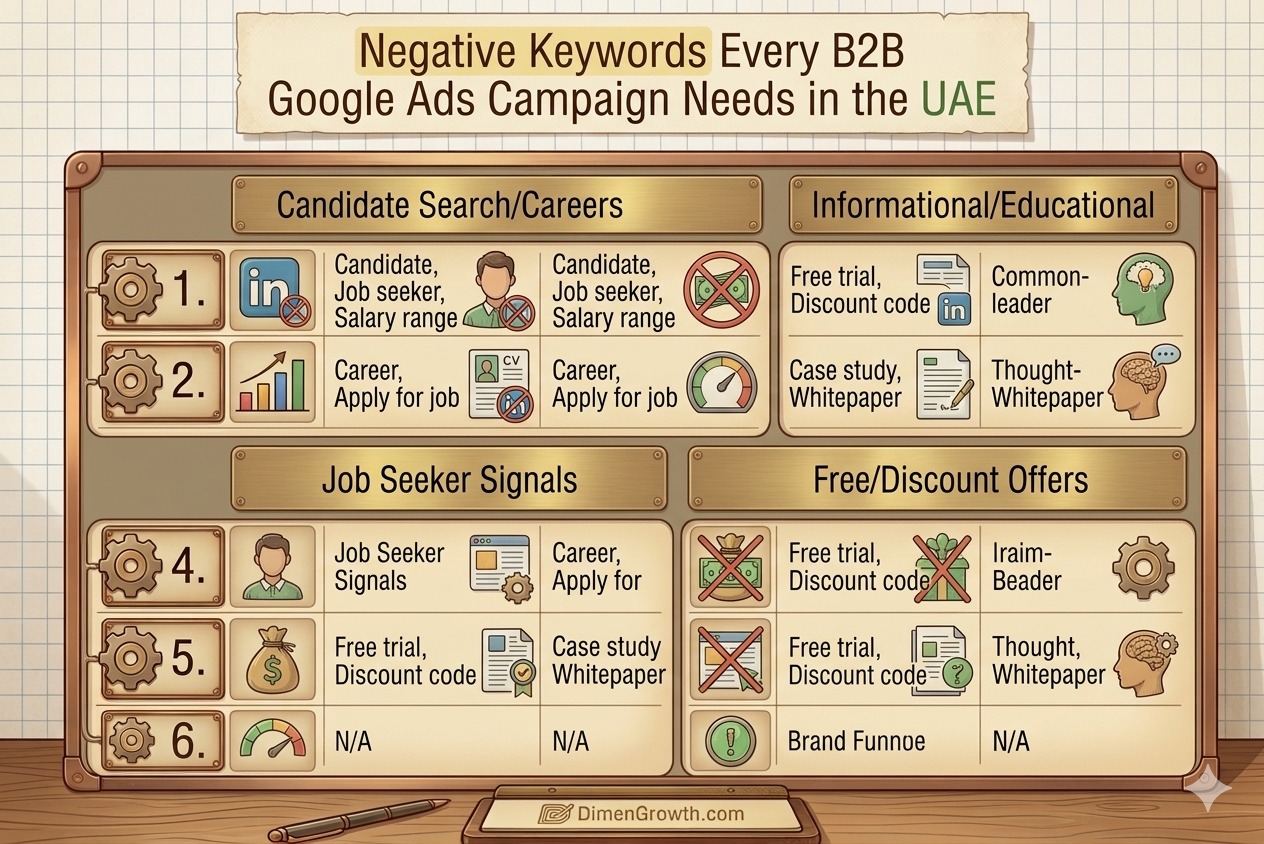
This is a comprehensive negative keyword list organised by category, with UAE-specific additions that most generic negative keyword resources miss entirely. Use this list as your baseline. Add to it continuously using your Search Terms Report.
| Key TakeawaysA comprehensive negative keyword list is the fastest, zero-cost way to reduce B2B Google Ads wasted spendUAE-specific negatives include visa-related terms, PRO services, and non-commercial regulatory queries unique to the marketJob and career-related terms are the largest category of B2B budget waste across most industriesFree, DIY, and consumer-intent terms attract traffic with zero purchase intent for B2B servicesInformational queries consume significant budget without contributing to pipeline or lead generationThe list below covers 101 core negatives; your Search Terms Report will expand this to 300 or more over 90 days |
Why Negative Keywords Matter More in the UAE B2B Market
Google Ads match types have broadened significantly over the past three years. Phrase match and even exact match keywords now trigger for semantically related queries that share intent according to Google’s machine learning models. In practice, this means a B2B keyword like “marketing automation” can trigger for “marketing automation for students,” “marketing automation definition,” or “marketing automation jobs Dubai” without those terms appearing in your keyword list.
In the UAE, this problem is compounded by the diversity of the professional population. Dubai and Abu Dhabi attract professionals from over 200 nationalities, many of whom are actively searching for employment opportunities, visa information, and business setup guidance. These searches create a unique category of UAE-specific irrelevant queries that do not appear in generic B2B negative keyword resources. Our Google Ads agency in Dubai works with regional B2B companies specifically on eliminating this local budget waste.
The categories below cover every major source of B2B negative keyword waste, including a UAE-specific section that is particularly valuable for businesses advertising to local decision-makers.
Category 1: Job and Career-Related Terms
Job-related searches are the largest single category of wasted spend for B2B advertisers. When your keyword is a product or service category, Google’s broad matching frequently triggers your ad for job seekers searching for roles in that category. A B2B software company targeting “CRM software” will trigger for “CRM software jobs,” “CRM developer career,” and “CRM administrator vacancy” without job-related negatives in place.
Add all of the following as phrase match negatives. This allows you to exclude “marketing jobs” while still capturing queries like “marketing software for job boards” where the word job appears in a commercial context. For a full guide on match type strategy in B2B campaigns, our B2B Google Ads agency team covers this in detail.
| Job-Related Negative Keywords (add as phrase match) |
|---|
| job | jobs near me | vacancy | vacancies | career | careers |
| hiring | recruitment | internship | intern | apprentice | trainee |
| salary | wages | employment | work from home jobs | part time | full time job |
| entry level | fresher | graduate job | job description | job spec | resume template |
| cv template | cover letter | interview questions | job portal | naukri | bayt |
Category 2: Free, DIY, and Low-Cost Intent Terms
The word “free” is the clearest signal of non-commercial intent in search advertising. Anyone searching for a free version of your product or service has explicitly indicated they are not willing to pay, which means they are not a B2B buyer. Similarly, DIY and budget-intent modifiers signal that the searcher is looking for a self-service solution that falls outside the scope of most B2B services.
This category is particularly important for SaaS companies, agencies, and professional services firms whose product or service category has a consumer-grade free alternative. If you offer enterprise SEO services and your competitor offers a free tool, you need to block searches that are clearly oriented toward the free option. For B2B companies combining Google Ads with LinkedIn Ads, this negative list applies to your LinkedIn Lead Gen Form campaigns as well when keyword targeting is used.
| Free / DIY / Low-Cost Negative Keywords |
|---|
| free | free trial | freemium | open source | no cost | zero cost |
| cheap | cheapest | budget | low cost | affordable alternative | free version |
| DIY | do it yourself | how to do it yourself | free tools | free software | free template |
| free download | free guide | free course | free certification | free training | free resource |
Category 3: Education and Academic Intent Terms
Education-intent queries are a significant source of irrelevant traffic for B2B companies in solution categories that also have academic or professional training dimensions. A B2B cybersecurity company will see educational traffic from IT students. A B2B accounting software company will see traffic from accounting students researching for assignments. A B2B HR platform will attract HR management course students.
The UAE university and college population is large and active on Google, particularly for research-related queries. Dubai and Abu Dhabi host dozens of international university campuses, and students from these institutions routinely search for the same terms that B2B buyers use when researching solutions. Without education-intent negatives, a meaningful share of your B2B ad budget reaches students with no purchase authority or intent.
| Education / Academic Negative Keywords |
|---|
| course | courses | tutorial | tutorials | certification | certified |
| learn | learning | training | training program | workshop | webinar free |
| university | college | student | students | academic | research paper |
| thesis | dissertation | assignment | textbook | syllabus | curriculum |
| exam | examination | quiz | test prep | study guide | lecture notes |
Category 4: Consumer and B2C Intent Terms
B2C and consumer-intent terms attract individuals shopping for personal use, not business procurement. For most B2B services companies, a personal-use buyer is not a qualified lead regardless of their seniority or industry. A CFO looking for personal accounting software is not the same buyer as a CFO procuring enterprise financial management software for their organisation.
Consumer-intent negatives are particularly important for B2B companies in categories with strong consumer alternatives: productivity software, design tools, communication platforms, and any SaaS product with a personal plan. If you run Meta Ads alongside Google Ads, note that consumer-intent signals are far more common on Meta and require different creative and audience strategies to filter for B2B buyers.
| Consumer / B2C Negative Keywords |
|---|
| personal | personal use | for home | home use | individual | consumer |
| small business personal | sole trader personal | freelancer personal | self employed personal | B2C | retail |
| Amazon | eBay | Noon | Carrefour | IKEA | buy online cheap |
Category 5: UAE-Specific Non-Commercial Terms
This is the most important category for businesses advertising specifically to UAE audiences and the one most commonly missing from generic B2B negative keyword resources. The UAE’s unique regulatory, immigration, and business setup environment generates a high volume of searches that share terminology with B2B service categories but are entirely non-commercial from a B2B perspective.
Visa-related searches are the most prevalent. A company advertising HR software will trigger for visa processing queries. A company advertising payroll services will trigger for WPS compliance queries from individuals, not businesses. A company advertising legal services will trigger for personal visa application guidance. A company advertising business consulting will trigger for company formation queries from first-time entrepreneurs who are not yet at the procurement stage.
For B2B companies running SEO for B2B in the UAE alongside Google Ads, these same UAE-specific intent signals affect organic content strategy. Terms that attract non-commercial organic traffic should also be excluded from paid campaigns to maintain audience quality across channels.
| UAE-Specific Non-Commercial Negative Keywords |
|---|
| visa | UAE visa | Dubai visa | work permit | residence visa | tourist visa |
| golden visa | freelance visa UAE | employment visa | visa status | visa application | visa fee |
| PRO services | typing centre | notary | attestation | trade licence renewal | Ejari |
| DEWA connection | municipality approval | sponsor transfer | labour card | MOHRE | WPS |
| shareholder | partner visa | investor visa | company formation free zone | mainland licence | offshore company |
Category 6: Informational and Research Intent Terms
Informational queries are searches where the user wants to understand a topic, not purchase a solution. These queries generate clicks and costs without generating leads. The challenge for B2B advertisers is that informational queries often use the same vocabulary as commercial queries, making them invisible to broad or phrase match keyword strategies without explicit negative keyword exclusions.
Informational intent is also the most common query type at the top of the B2B buying funnel. While these queries can be valuable for organic content and B2B SEO strategy, they are rarely cost-effective for paid search. The exception is if you are intentionally running awareness campaigns using content offers as landing pages, in which case you would selectively allow some informational queries for that specific campaign while blocking them from conversion-focused campaigns.
| Informational / Research Intent Negative Keywords |
|---|
| what is | what are | definition of | meaning of | explain | examples of |
| history of | origin of | how does | why does | when did | who invented |
| difference between | vs | compare | comparison | pros and cons | advantages disadvantages |
| statistics | statistics 2024 | statistics 2025 | report | annual report | industry report free |
Category 7: Competitor Non-Commercial Terms
If you are running competitor keyword campaigns targeting your competitors’ brand names, you want to exclude the non-commercial queries people use when they are already customers of that competitor seeking support, documentation, or career information. These queries have zero conversion value for your campaign because the intent is to engage with the competitor’s existing product, not to evaluate alternatives.
Replace [competitor name] in the table below with the actual names of your direct competitors. If you are targeting five competitors, create five versions of this exclusion pattern and add all of them to your shared negative keyword list.
| Competitor Non-Commercial Negative Keywords (customise with actual competitor names) |
|---|
| [competitor name] login | [competitor name] support | [competitor name] review | [competitor name] careers | [competitor name] jobs | [competitor name] free trial |
| [competitor name] tutorial | [competitor name] documentation | [competitor name] API | [competitor name] pricing reddit | [competitor name] glassdoor | [competitor name] complaints |
Category 8: Geographic Exclusions for UAE-Focused Campaigns
If your B2B services are UAE-specific or GCC-specific, adding geographic negative keywords prevents your ads from appearing for searches that include location modifiers for markets outside your service area. This is particularly relevant for service categories where global searches share vocabulary with UAE-specific searches.
Note that geographic negative keywords in the list below are supplementary to your campaign location targeting settings. Google’s location targeting should be your primary geographic filter. These keyword-level exclusions catch queries where the user has included a foreign location modifier in their search term, which can bypass location targeting in some configurations. Our Google Ads agency Dubai team implements both levels of geographic control for all UAE B2B campaigns.
| Geographic Exclusion Negative Keywords (if UAE-only campaigns) |
|---|
| India | Pakistan | Egypt | Philippines | Nigeria | Kenya |
| Bangladesh | Sri Lanka | Nepal | Ethiopia | Ghana | Tanzania |
| UK only | USA only | Australia only | Canada only | South Africa only | Malaysia |
Category 9: Additional Non-Commercial Terms
This final category covers miscellaneous non-commercial query types that appear across B2B industries: social media and forum traffic, complaint and support queries from existing customers of other brands, and sample or template requests from users looking for free resources rather than paid solutions.
| Additional Non-Commercial Negative Keywords |
|---|
| Reddit | Quora | forum | community | discussion | thread |
| news | breaking news | latest news | article | blog post free | Wikipedia |
| sample | example | template free | demo free | mockup free | prototype free |
| complaint | complaints | review negative | scam | fraud | fake |
| refund | cancel subscription | how to cancel | unsubscribe | delete account | customer service number |
How to Implement This Negative Keyword List in Google Ads
Step 1: Create a Shared Negative Keyword List
In your Google Ads account, navigate to Tools and Settings, then Shared Library, then Negative Keyword Lists. Create a new list called “B2B Master Negatives” and add all the keywords from this guide. Apply the shared list to every campaign in your account. When you add new negatives to the shared list, they automatically apply to all linked campaigns without manual updates per campaign.
Step 2: Choose the Right Match Type for Each Negative
Use phrase match negatives for most terms in this list. Phrase match negative for “free” will block searches containing the word free anywhere in the query while allowing searches like “freedom software” or “free enterprise (as in the economic concept).” Use exact match negatives only for very specific terms where you want to block the exact query but allow variants. Broad match negatives are rarely appropriate for B2B campaigns.
Step 3: Review Your Search Terms Report Weekly
This list of 101 negatives is your starting point, not your finished product. Every week, review your Search Terms Report for new irrelevant queries that have triggered your ads. Add each new irrelevant term to your shared negative list immediately. After 90 days of consistent review, most well-managed B2B Google Ads accounts have 300 to 500 or more negative keywords in place. For a guide on all the structural optimisations that complement negative keyword management, see our full breakdown of Google Ads mistakes B2B companies make.
Step 4: Add Campaign-Specific Negatives
Beyond the shared master list, each campaign may need its own specific negatives based on its keyword set and audience. A campaign targeting “LinkedIn advertising” should add negatives like “LinkedIn organic posts,” “LinkedIn algorithm,” and “LinkedIn profile tips” at the campaign level while keeping the shared master list at the account level. The master list handles universal exclusions; campaign-level negatives handle intent-specific exclusions unique to each campaign’s keyword theme.
Frequently Asked Questions
How many negative keywords should a B2B Google Ads campaign have?
Start with the 101 negatives in this guide as your baseline. After 90 days of active Search Terms Report review, a well-managed B2B Google Ads account in the UAE should have 300 to 500 or more negatives in place. There is no upper limit. Every irrelevant query you block redirects budget toward commercial-intent traffic. For campaigns being managed by an agency, ask specifically how many negatives are in the account. Fewer than 100 after 60 days of running is a clear sign of insufficient optimisation. Our Google Ads agency includes weekly Search Terms Report review and ongoing negative keyword expansion in every managed account.
Should B2B Google Ads use broad match, phrase match, or exact match for negative keywords?
Use phrase match for the majority of your negatives in this list. Phrase match negative blocks any query containing the negative keyword phrase in order, which catches most variants without being so restrictive that you accidentally block commercial queries. Use exact match negatives for very specific terms where the exact query is irrelevant but variants may be valuable. Avoid broad match negatives entirely, as they can accidentally block relevant commercial queries.
Do negative keywords apply to Performance Max campaigns in Google Ads?
Yes, but the implementation is different. For Performance Max campaigns, you add negative keywords at the account level via the account-level negative keyword list, or you can request campaign-level negatives through your Google rep for large accounts. Account-level negatives apply to all campaign types including Performance Max. This is another reason why building a comprehensive shared negative keyword list at the account level is the most efficient implementation approach.
How often should I update my B2B Google Ads negative keyword list in the UAE?
Review and update weekly for the first 90 days of a new campaign or account. After 90 days, bi-weekly review is sufficient for established campaigns. Set a recurring calendar reminder for your Search Terms Report review. Every session should produce at least five new negatives for a campaign that is generating meaningful impression volume. Stale negative keyword lists are a common cause of gradual CPL increase in accounts that performed well initially.
Are there UAE-specific negative keywords that B2B companies miss most often?
The most commonly missed UAE-specific negatives are visa-related terms, PRO and government services terminology, free zone company formation queries, and WPS and MOHRE compliance searches. These terms appear frequently in UAE search data for B2B service categories because the UAE’s regulatory and immigration environment generates a high volume of business-adjacent searches from individuals and new entrepreneurs who are not yet qualified B2B buyers.
Start With These 101 Negatives and Never Stop Adding
The negative keywords b2b google ads UAE list in this guide is the foundation of a properly managed B2B search campaign. Implement it today, review your Search Terms Report weekly, and treat your negative keyword list as a living document that grows with your campaign data. Every term you add saves budget. Every irrelevant click you block is a click that stays in the auction for a buyer who is actually ready to purchase. For a full audit of your current Google Ads account including negative keyword coverage, match type strategy, and conversion tracking accuracy, our B2B Google Ads team provides account audits for B2B companies across the UAE and GCC.
Running Google Ads alongside LinkedIn for full B2B funnel coverage? Our guides on LinkedIn ad ideas that fill B2B pipelines and LinkedIn ads funnel strategies for long sales cycles cover the demand creation side of the equation while Google Ads handles demand capture.
Ready to stop wasting B2B Google Ads budget on irrelevant queries? Book a free account audit with our Google Ads team in Dubai.
Related reading: 10 Google Ads Mistakes That Kill B2B Campaigns | SEO for B2B in the UAE | LinkedIn Ads for B2B
Sources: Google Ads Negative Keywords | WordStream Negative Keyword Guide