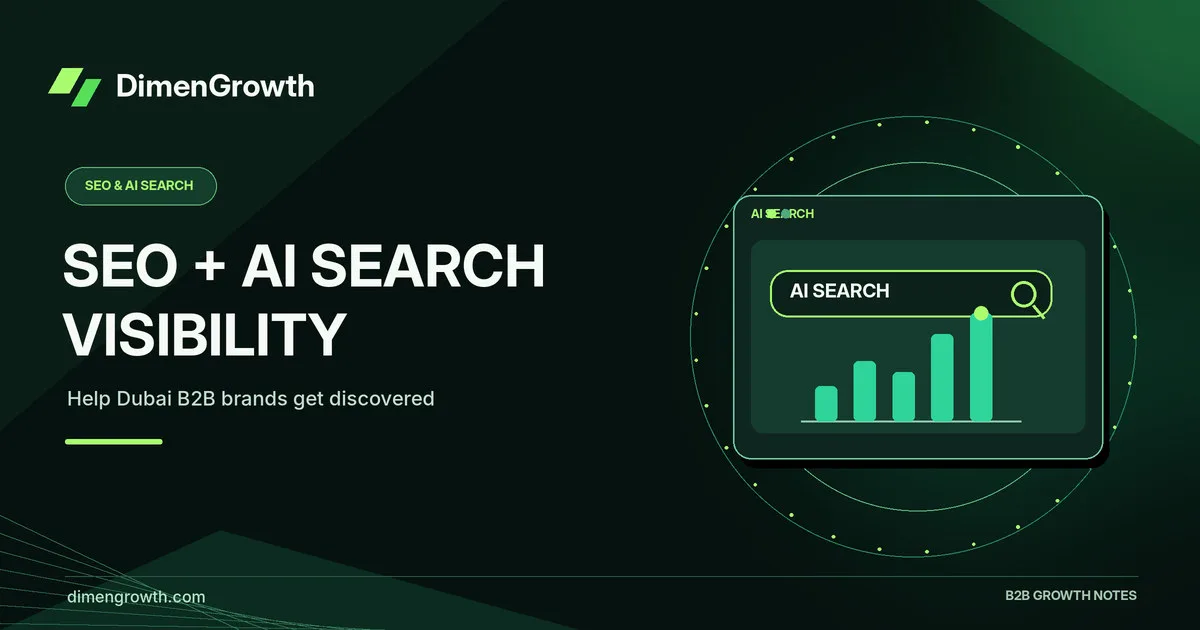
Dubai B2B buyers may discover a service through search, an AI answer or a recommendation they share internally. Make service information consistent and useful across those routes, support key claims with evidence, and track which visits lead to qualified enquiries.
Quick answer
Improve the underlying website first: make important service pages crawlable, answer real buyer questions with verifiable detail, connect related pages through useful links and keep organization facts consistent. For AI-generated search answers, there is no reliable shortcut or guaranteed citation formula. Search engines and assistants may draw on pages that are accessible, distinctive and relevant, but inclusion depends on each system’s retrieval and ranking decisions.
Define useful visibility outcomes
Separate four things in your reporting: conventional organic visibility, visits from identifiable AI referral sources, appearances or citations in answer experiences where measurement is available, and qualified enquiries. A screenshot of your brand in one AI answer is evidence of that answer, not evidence of an ongoing ranking position.
Choose a manageable set of questions a prospective buyer would ask before hiring a Dubai B2B agency, such as which channels fit a technical service or how to measure qualified leads. Review those questions regularly while recognizing that answers can vary by user, location and context.
Audit crawlable service content
Start with each commercial page: Google Ads, LinkedIn Ads, SEO, AI visibility and marketing automation. Check that the page returns a valid response, is indexable when intended, uses a sensible canonical URL and contains its key information as visible HTML text. Don’t hide the only useful explanation behind a form, screenshot or script-dependent interaction.
Verify service eligibility, geographic coverage and contact details against the current business. An AI system cannot accurately summarize a company when the homepage, service page and business profile contradict one another.
Answer buyer questions directly
Lead with a specific answer, then explain the conditions. If the question is whether LinkedIn Ads work for Dubai cybersecurity firms, discuss buying committee size, targeting constraints, offer quality and long sales cycles before talking about your agency. A clear opening paragraph is useful for humans as well as for snippets and generated summaries.
Use descriptive H2 headings that match genuine questions, not dozens of near-identical long-tail keywords. Add a decision table or short worked example only when it makes a complex comparison easier to understand.
Develop original subject expertise
Generic explanations of CPC, SEO and funnels are readily available. Add something the reader could learn from your real work: a documented troubleshooting process, anonymized campaign setup, practical measurement checklist or explanation of why a recommended tactic failed in a particular situation. Obtain client approval before publishing identifiable results.
Separate observed facts from opinions and illustrative scenarios. Do not invent conversion lifts, ROI statistics, client quotes or experiment results. Originality comes from useful judgment and traceable evidence, not unusual adjectives.
Build clear entity and service information
Keep the business name, brand spelling, primary location, service scope and contact paths consistent on the homepage, About page and core service pages. Describe what DimenGrowth actually delivers and which businesses it serves. When a service is limited to a location or industry, state the constraint instead of implying worldwide coverage.
Connect related pages naturally: for example, an AI visibility article can refer readers to AI Search Visibility for the service and SEO for B2B in the UAE for the organic foundation.
Use accurate structured data
Article, WebPage, BreadcrumbList and Organization markup can help machines interpret a page when it reflects the visible content. Check that author attribution, publication dates, URLs and images are accurate. Adding unsupported ratings, fabricated reviews or FAQ markup that isn’t eligible for a rich result is not a legitimate optimization.
Structured data can improve eligible search features, but it does not compel a language model to mention your company. See Google’s structured data introduction for implementation principles.
Improve internal linking architecture
Build clear paths from informational posts to their relevant service and supporting articles. For example, a guide to LinkedIn costs should point to a LinkedIn planning page; a conversion-tracking article can link to a B2B attribution explanation. Use anchors that explain what is behind the link, not repeated exact-match keyword strings.
Review orphan pages and ensure that important articles receive links from related, indexable pages. A logically connected topic cluster helps readers navigate and makes crawling more reliable. Avoid adding every service link to every article.
Avoid mass produced thin pages
Do not publish separate articles for every small phrase variation if they answer the same buying question. Merge overlapping pages or make their purpose genuinely distinct through audience, evidence or product scope. A 5,000-word post made of repeated generalities is not more helpful than a concise, original answer.
Google’s policies specifically warn about scaled, unoriginal content created primarily to manipulate rankings. Treat template-like passages as an editorial quality problem regardless of whether a person or AI system drafted them. Refer to Google’s spam policies for the current standard.
Maintain factual freshness
Review anything that changes: advertising platform settings, attribution options, UAE regulations, product availability and service pricing. Link to primary documentation when a claim depends on a third party. Display dates accurately and revise substantive details when they change rather than merely changing the year in a heading.
For evergreen strategy articles, updating one inaccurate example may matter more than rewriting the introduction. Give each commercial page a clear owner who can confirm the service description is still correct.
Monitor search console signals
Use Search Console to find pages with impressions but weak query alignment, indexing problems, accidental canonicalization or declining performance. Inspect query groups by buyer intent before making title changes. A page ranking for general career queries may need clearer B2B positioning rather than more keyword repetitions.
Google’s AI features use the underlying Search ecosystem, and current guidance says to keep following standard SEO best practices. Review Google’s guidance for AI features when planning measurement and site changes.
Evaluate AI referrals cautiously
Where referral data is available, group identifiable sources separately from organic search and direct traffic. Remember that some answer experiences provide citations without visits, and a large share of discovery may not be attributable to a single referrer.
Track qualified form submissions, consultations and assisted opportunities from identifiable traffic, but describe uncertainty clearly. Do not extrapolate a small sample of prompts into a universal “share of AI answers” figure.
Build trustworthy citations and references
When the article depends on a changing policy, technical feature or legal requirement, link to the source that establishes the fact. For campaign tactics, show a reproducible method; for customer results, identify the measurement window and obtain publishing permission. A citation to a reputable source should support a claim, not decorate it.
Make your content worth referencing in its own right by publishing original comparisons, checklists, carefully scoped definitions and clear examples. External links are useful when they help a reader verify something that matters.
Connect discovery to qualified pipeline
Define which inbound conversations are commercially relevant before assigning credit to search or AI discovery. For DimenGrowth, a meaningful enquiry might identify a B2B service, target market, campaign or website problem and a buyer who can discuss the project. A generic newsletter signup is a different outcome.
Use CRM qualification to connect discovered content to later opportunities, while acknowledging that procurement decisions often involve colleagues who never visit the site. Our B2B marketing attribution guide explains these reporting limitations.
Create a sustainable update schedule
Assign a monthly technical check for indexing and a quarterly editorial review for key service clusters, with faster updates after material platform changes. Record the original claim, its evidence, the revision and the person who approved it. Focus first on pages that influence purchasing decisions or attract mismatched traffic.
Watch for keyword cannibalization as your library grows. A new post should answer a question not already answered adequately by an existing page.
A practical 90 day implementation roadmap
Month 1: technical and editorial baseline
Validate indexing, canonicals, Article markup, core service facts and existing links. Map the highest-intent questions to one primary destination each and identify pages dominated by repeated generic wording.
Month 2: publish useful evidence
Rewrite weak pages with answer-first content, buyer examples and accurate source links. Add descriptive internal links from related articles; verify that each page displays correctly and that important claims can be checked.
Month 3: measure and maintain
Review search performance, observable AI referrals, qualified enquiries and sales feedback. Update what buyers found confusing. Do not infer success from a handful of test prompts or assume that citation eligibility guarantees placement.
A practical AI visibility evidence hierarchy
| Dimension | What to improve | Evidence |
|---|---|---|
| Search eligibility | Indexability, HTML content and accurate canonicals | Search Console and page inspection |
| Content usefulness | Unique buyer answer and verifiable source | SME review and user feedback |
| Commercial value | Qualified enquiry and opportunity evidence | CRM outcomes and reporting limitations |
Frequently asked questions
Can a page be guaranteed to appear in ChatGPT or Google’s AI answers?
No. Retrieval, ranking, licensing and product behaviour vary. Strong technical SEO and distinctive content improve your foundation but cannot promise a citation.
Does adding FAQ schema guarantee AI visibility?
No. Structured data should accurately represent visible information and is primarily useful for search engines’ supported features. Write helpful questions because buyers need answers.
Should Dubai B2B brands create one page for every AI prompt?
Usually not. Organize content around distinct buyer problems and avoid duplicate pages that differ only by wording.
What should a useful AI visibility report include?
Track indexing and relevant organic queries, identifiable AI referrals, qualified consultations, citation observations where available and the limitations of each metric.
Is there a preferred article length?
No universal length. Use enough detail to solve the question and remove sections that only restate the same advice.
Work with Dimen Growth
Dimen Growth helps businesses connect audience research, paid media, SEO and conversion improvement with measurable sales outcomes. Explore our B2B SEO services in the UAE or book a strategy call to discuss your UAE growth priorities.