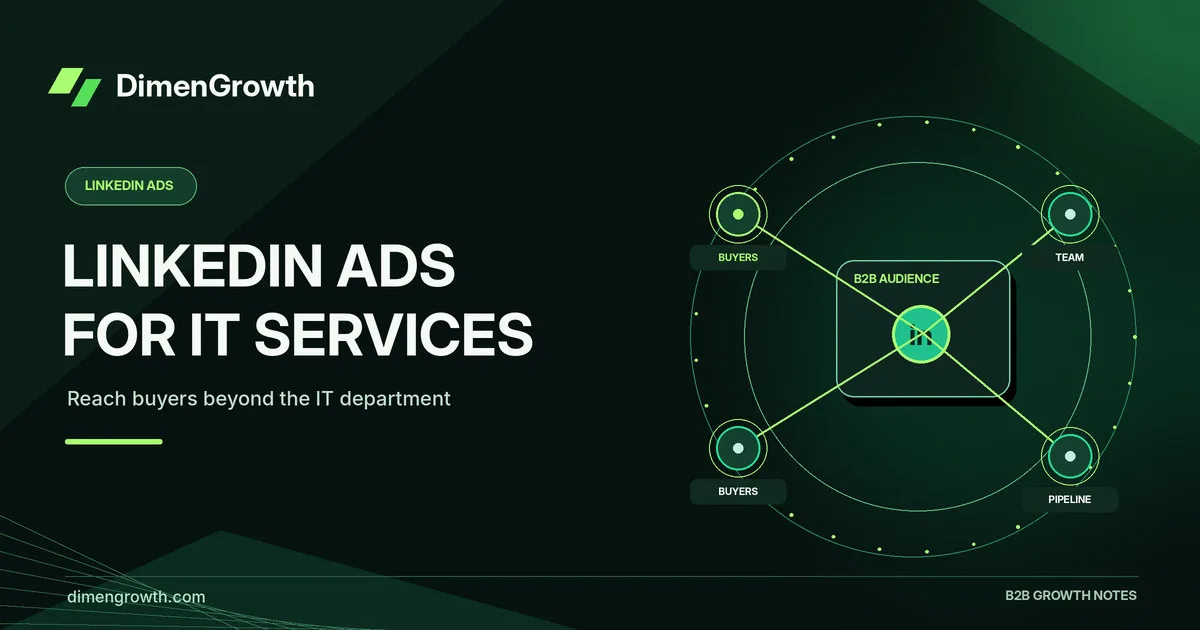
An IT services buying committee is rarely limited to the IT manager. Operations wants continuity, finance wants predictable cost and security teams may need evidence about access and controls. LinkedIn Ads can reach those stakeholders, but a single generic “managed IT solutions” message rarely answers their different concerns.
Start from actual service scope and account fit, then build offers and measurement around qualified conversations rather than inexpensive lead forms.
Quick answer
Define ideal customers by workload, environment, organization size, service area and willingness to purchase ongoing support. A managed services provider targeting multi-site companies should not mix that audience with consumers seeking one-off computer repairs. Connect each eligible segment to a service the team can deliver.
Define service specific ICPs
List the roles involved: IT operations, infrastructure, finance, procurement, risk and leadership. An operations lead may want escalation rules; a CFO may want contract boundaries; the technical evaluator may ask about deployment and integrations. Prepare messages that reflect those decision points.
Map technical and commercial stakeholders
Choose accounts based on real fit and commercial potential rather than buying a broad list of technology employers. Check company status, geography and service requirements before uploading lists. Treat account matching as a reach mechanism, not proof that everyone at the company is evaluating a provider.
Choose account lists thoughtfully
Use job functions and seniority levels to construct reasonable audiences where supported, but account for ambiguous job titles and small sample sizes. Test whether the resulting prospects hold the responsibilities you expected. Avoid hyper-segmentation that prevents delivery without improving relevance.
Use job function targeting with care
Open with a concrete operational pain: recurring endpoint incidents, complex onboarding, unpredictable support scope or slow internal escalation. Explain how the service addresses that problem and what the buyer must evaluate. Avoid unqualified promises of zero downtime or guaranteed cost reductions.
Build offers around operational pain
Describe which platforms, locations and support hours are covered, what monitoring includes and where responsibilities change hands. A clear service scope can qualify out buyers who need a different offering. If the service includes security, explain which controls and obligations are genuinely provided.
Explain managed service scope clearly
Document Ads can distribute a migration checklist, managed support comparison or vendor evaluation worksheet. Make the document valuable without a sales call and label any gated follow-up transparently. See our LinkedIn Document Ads playbook for format considerations.
Create educational document campaigns
Use evidence the audience can inspect: real engineering explanations, documented onboarding steps, certifications with correct scope and client stories approved for publication. Do not substitute AI-generated testimonials or invented deployment metrics for credibility.
Develop credibility with real expertise
Build a landing page for the relevant IT service rather than sending every ad to the agency or provider homepage. Include supported environments, implementation process, qualification questions and an appropriate next step. Our LinkedIn Ads for hosting and cloud companies page covers infrastructure-specific support.
Connect ads to relevant service pages
Retarget only where platform policies and privacy requirements permit. Offer next-stage information related to what visitors explored, such as migration responsibilities or contract terms. Exclude irrelevant audiences and watch frequency on small professional segments.
Use engagement retargeting appropriately
A qualified meeting should involve an organization with a plausible workload, service fit and a buyer able to progress evaluation. Track booked versus attended calls, and use sales notes to distinguish educational interest from active procurement.
Qualify meetings before reporting wins
Start with a reach and frequency estimate for the eligible accounts, then build spend scenarios around possible qualified meeting rates. A narrow audience may produce meaningful conversations without rapid learning in the ad platform. Do not invent a universal IT services CPL benchmark.
Plan budget for smaller audiences
Coordinate ad messages with legitimate account outreach but avoid repetitive automated contact from multiple team members. Review existing client and opportunity status first. Content should help a buyer evaluate an option even if they do not respond to an invitation.
Coordinate outreach without spamming
Track engagement as a diagnostic and report qualified assessments, proposals and opportunities over the full buying cycle. A multi-stakeholder sale may involve searches, internal recommendations and direct contact beyond paid attribution. Our LinkedIn ABM guide explains how to interpret account engagement.
Measure pipeline over the full cycle
Month 1: define service fit, buyer roles and conversion stages. Month 2: pilot one focused buying scenario with the right service page. Month 3: review qualified meetings and technical objections with sales; refine before increasing audience size or spend.
How to turn the strategy into a working plan
In the first month, audit the current IT services journey and agree on lead qualification rules. Record what prospects ask, what information is missing and which events are actually tracked. During the second month, test one focused campaign or content improvement and review enquiries with sales. In the third month, compare outcomes with the baseline, correct measurement problems and expand only the elements supported by evidence. This sequence is a planning framework, not a guaranteed timetable for revenue.
IT services messages by stakeholder
| Situation | Recommended approach | What to check |
|---|---|---|
| Technical evaluator | Supported environments, integration and support boundaries | Qualified workload discussion |
| Operations leader | Escalation and service continuity process | Relevant service assessment |
| Finance or procurement | Contract scope and commercial accountability | Procurement-ready enquiry |
Frequently asked questions
Which decision makers should IT services companies target?
Map who evaluates, approves and uses the service. Titles vary; IT, operations, finance and procurement may all be involved.
What offer works better than a generic demo?
A specific migration checklist, managed-service comparison or technical assessment matched to a known buyer concern.
Are LinkedIn lead forms sufficient for qualification?
Not alone. Review the company, workload, service fit and whether the meeting advances real evaluation.
Should small IT audiences be heavily segmented?
Only as far as reach supports learning. Excessive layers can make campaigns too narrow without improving buyer relevance.
How long should we judge performance?
Use early engagement as a diagnostic, but evaluate meaningful pipeline over the actual IT services sales cycle.
Work with Dimen Growth
A useful strategy makes the next buyer decision easier and gives your team a clearer view of commercial outcomes. Explore our LinkedIn Ads management for B2B companies or book a strategy call to discuss the audience, offer and measurement approach that fits your business.