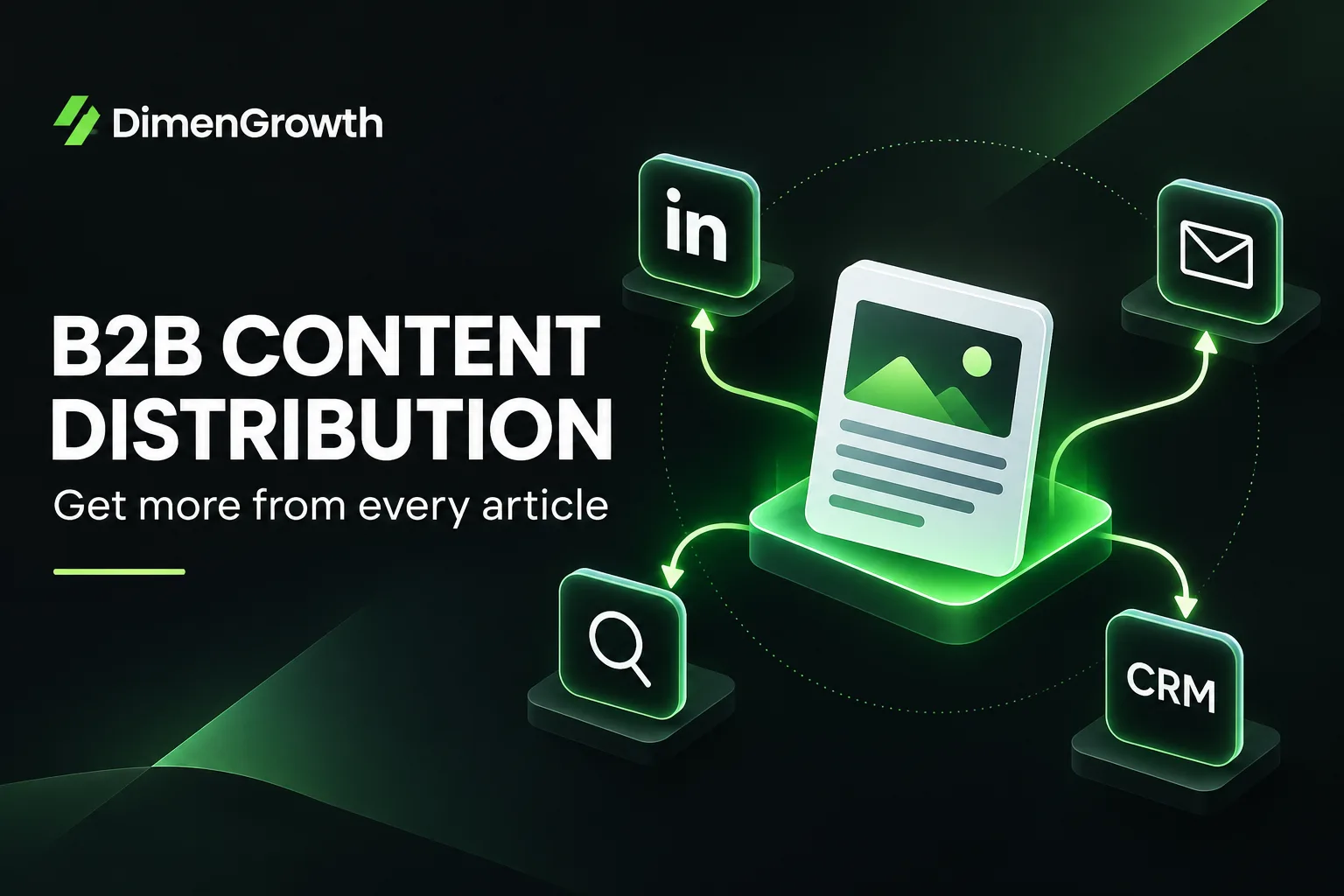
Publishing an article is not a distribution strategy. A useful guide can disappear after a single LinkedIn post, while an average one gets reshared endlessly without reaching a buyer. The question is not how many channels you can fill. It is which people need the information, what they will do with it and how that interest might develop into an opportunity.
For a B2B company selling a complex service, distribution should follow the buying journey. A technical evaluator may want a diagram, an operations leader may want a checklist and a finance stakeholder may need a cost or risk explanation. Here is how to turn one substantive article into a coordinated set of useful touchpoints without copying the same promotional message everywhere.
Quick answer
Choose one buyer question and publish the strongest answer you can support. Adapt that answer into a handful of channel-native assets, link back to the source when more depth is needed and define a meaningful outcome for each asset. Measure return visits, relevant enquiries and opportunities alongside channel engagement, not instead of them.
Start with a distribution objective
Write the decision you want to influence before planning posts. For example, a procurement team comparing managed cloud providers may need a clear explanation of migration ownership before it requests proposals. A distribution objective could be to get that migration checklist in front of technical and operations stakeholders at relevant accounts, not simply to reach 10,000 people. Editorial co-distribution and compensated referral partnerships are different arrangements. For the latter, see our hosting affiliate marketing strategy covering partner quality, disclosure and attribution.
List the buyer role, the question, the proof you can provide and the next helpful action. That action might be reading a technical comparison or booking a scoping conversation. If the source article cannot genuinely answer the question, improve it before amplifying it.
Map channels to reader intent
Use search for people already asking the question, LinkedIn for relevant industry and buying-committee conversations, email for audiences that have opted in and specialist communities when you can contribute useful expertise. These audiences behave differently. A headline that works in search may sound like an unwanted sales pitch in a professional forum.
Map one asset to one job. A search landing page provides the complete explanation; a LinkedIn post illustrates a surprising trade-off; a customer email responds to a concern raised earlier. Our B2B content marketing guide for Dubai covers how to identify those questions in sales conversations.
Package one idea for different contexts
Start from a specific point, not an entire 2,000-word article. A guide to hosting migration might contain a short risk matrix, an implementation timeline, a buyer checklist and an objection about downtime. Each can stand alone as an image, short post or document.
Keep the facts identical across formats. Do not turn a qualified observation into an absolute claim for the sake of a punchier headline. When a concept needs context, send readers to the original article rather than burying all its nuance in a carousel.
Build a newsletter workflow
Segment an opted-in list by the problems people have demonstrated interest in. A prospect exploring paid acquisition does not need the same email as an existing customer looking for implementation guidance. Introduce the problem in one sentence, offer one practical takeaway and link to the section that answers it.
Watch replies, qualified click-throughs and unsubscribes. A small list of relevant buyers may outperform a larger list attracted by unrelated downloads. Respect subscription preferences and stop promoting material that people repeatedly ignore.
Use LinkedIn executives and employees
Have subject-matter experts explain the judgement behind the article, not recite its opening paragraph. A CTO could describe a migration trade-off; a sales lead could discuss a recurring procurement objection; a marketing lead could show how a measurement decision changed reporting.
Give contributors a few accurate talking points and let them use their own language. Avoid identical employee posts and forced engagement campaigns. If using paid support, see our LinkedIn ad ideas for B2B pipeline for formats that preserve a genuine point of view.
Repurpose research into paid creative
Look for a verifiable insight that explains a buyer problem. It might be a diagram of the approval process, a comparison of two implementation approaches or a checklist derived from recurring sales questions. Turn that insight into the advertisement; make the full article the optional next step.
Keep paid objectives separate from editorial reach. A top-of-funnel document view and a booked qualified consultation are different outcomes. Do not claim that a strong engagement rate proves the content generated revenue.
Make technical communities a priority
Read community rules and existing discussions before contributing. Developers and infrastructure buyers notice vague sales copy immediately. Answer the underlying question, explain assumptions and reference a product only if it genuinely solves the issue under discussion.
A useful community post might contain a sample configuration, a troubleshooting checklist or a candid account of trade-offs. The link to your article should add detail rather than substitute for an answer. Our Reddit guide for B2B SaaS discusses how community context differs from standard paid placement.
Connect content with search discovery
Build a clear page title and heading structure around the question people search, then connect related pieces through descriptive anchors. A comparison article should link to the relevant solution page and to more detailed implementation guidance. Avoid making every anchor the same exact-match keyword.
Use Search Console to see which queries already surface the page and whether impressions lead to meaningful visits. Improve information gaps before rewriting headlines for the latest trend. Search content should remain understandable without arriving from a particular social campaign.
Coordinate webinars and partner distribution
A partner webinar can extend the life of an article when the partner reaches a genuinely complementary audience. A logistics software provider, for instance, might co-host a session on integration requirements with an implementation partner. The partner brings a different perspective instead of simply repeating your brand story.
Agree on the audience, promotion responsibilities, registration permissions and what participants will receive. Afterwards, turn unanswered questions into updates to the original article. Do not equate registrations with buyers; review attendee fit and follow-up conversations.
Track assisted pipeline cautiously
Tag distributed links consistently and separate engaged visitors, enquiries, sales-accepted leads and opportunities in reporting. In a multi-stakeholder sale, a contact may encounter several assets before speaking to sales. Attribution models can describe part of that path but rarely reveal the entire purchasing discussion.
Review the time between first content interaction and useful sales conversations, alongside qualitative feedback. Our B2B attribution guide explains why channel credit needs to be interpreted carefully rather than presented as a perfect causal measure.
Refresh evergreen material
Put a review owner and date against articles that depend on changing platform features, prices or regional regulations. A guide can keep ranking while quietly becoming inaccurate. Updating one outdated screenshot or qualification can be more valuable than publishing another near-identical post.
Use changes in product scope, sales objections and search queries to decide what to revise. Keep original claims traceable and avoid changing the publication date solely to create an appearance of freshness.
Avoid low value syndication
Republishing the entire article on every network often creates extra maintenance without a better reader experience. Instead, summarize an argument for that audience, credit the original source and offer the full piece when it genuinely adds value. Review syndication and canonical options where platforms allow them.
Choose partners by topical fit, not just follower counts. A specialist community with fewer readers can be more useful than a broad directory. Decline placements that require misleading anchor text or imply an endorsement that does not exist.
Create an editorial distribution calendar
Use a calendar that records the source URL, target audience, channel, asset owner, publication date and measurement question. One substantive article might produce a launch email, two expert posts, a short checklist and a relevant webinar prompt over several weeks.
Schedule review points, not just publishing slots. If a format attracts irrelevant contacts, revise the framing; if buyers ask the same question in calls, add that answer to the source. A calendar is useful only when it responds to what you learn.
Learn from qualitative feedback
Ask sales which articles prospects reference, what details remain unclear and which objections recur after someone reads them. Interviewing even a small number of relevant buyers can reveal whether a headline promised something the content never delivered.
Track recurring questions in a shared backlog and assign them to an article owner. This creates a feedback loop between distribution and editorial quality without relying on vanity engagement metrics.
How to turn the strategy into a working plan
Weeks 1–2: Select two high-intent articles, verify their claims and identify the buying roles they serve. Weeks 3–4: Create three channel-native assets for each, check tracking and launch through the channels those readers actually use. Weeks 5–8: Review qualified visits, replies, enquiries and sales comments; revise weak assets. Weeks 9–12: Repurpose the strongest questions into new original material and document what you have learned.
This is an operating sequence, not a promise of pipeline within 90 days. Match evaluation to your sales cycle and the size of your reachable audience.
Where distribution changes by buying stage
| Situation | Recommended approach | What to check |
|---|---|---|
| First research | Search guide and short explainer | Relevant question answered and qualified return visits |
| Technical evaluation | Specification or checklist from a credible expert | Meaningful follow-up questions |
| Commercial shortlist | Procurement notes and use-case comparison | Sales-accepted conversations |
Frequently asked questions
Should we distribute every article on every channel?
No. Choose channels where the intended buying role actually spends time and where the format adds something to the original explanation.
What should LinkedIn posts contain?
One useful observation or trade-off in the contributor’s own voice, supported by the source article when further detail is required.
How do we measure content distribution success?
Monitor qualified visits, relevant replies, enquiries and opportunities alongside reach. Keep attribution assumptions explicit.
Should we syndicate the full article?
Usually summarize and link to the source unless a partner offers a distinct audience and a clear editorial reason for republishing.
How can a small team sustain distribution?
Start with one substantial source and a few purposeful derivatives, then use sales feedback to decide what deserves another iteration.
Work with Dimen Growth
A useful strategy makes the next buyer decision easier and gives your team a clearer view of commercial outcomes. Book a strategy call to discuss the audience, offer and measurement approach that fits your business.