Long sales cycle B2B companies face a specific LinkedIn advertising challenge that short-cycle businesses do not: the gap between first contact and revenue is measured in months, not days. A single campaign, no matter how well-targeted or creative, cannot bridge a 90-day or 180-day buying journey on its own.
The linkedin ads funnel b2b long sales cycle problem is not a budget problem or a creative problem. It is an architecture problem. Most companies build LinkedIn campaigns for the 30-day conversion mindset when they need a 90-day to 180-day nurture and influence system. These 10 strategies build that system.
| Key Takeaways Long sales cycle B2B companies need a 90 to 180-day LinkedIn ad architecture, not single campaignsAuthority content at the top of funnel builds brand preference during the extended evaluation periodProgressive lead capture captures and qualifies intent at multiple points across the buying journeySales-aligned ABM sequences keep ads coordinated with pipeline stage and sales activityCompetitive displacement becomes critical when buyers are actively evaluating alternativesExecutive nurture tracks maintain C-suite visibility across the full duration of long deals |
Why Standard LinkedIn Funnels Fail for Long Sales Cycle B2B
Most LinkedIn ad frameworks are built for 30-day conversion cycles. They assume a buyer moves from awareness to lead to conversion in a single linear sequence. For B2B companies selling complex solutions with deal sizes above AED 100,000 or sales cycles longer than 60 days, this assumption is fundamentally wrong.
In a long sales cycle, the buying journey involves multiple stakeholders, multiple evaluation phases, competitive comparisons, internal approval processes, and extended periods of apparent inactivity where the buyer is still researching but not engaging with your ads. The question is not how to close faster. The question is how to maintain relevance and preference throughout a buying process you cannot control.
LinkedIn is uniquely positioned to answer that question because it allows you to reach B2B buyers during their professional consumption moments across weeks and months, not just when they are actively on your website or in your email sequence.
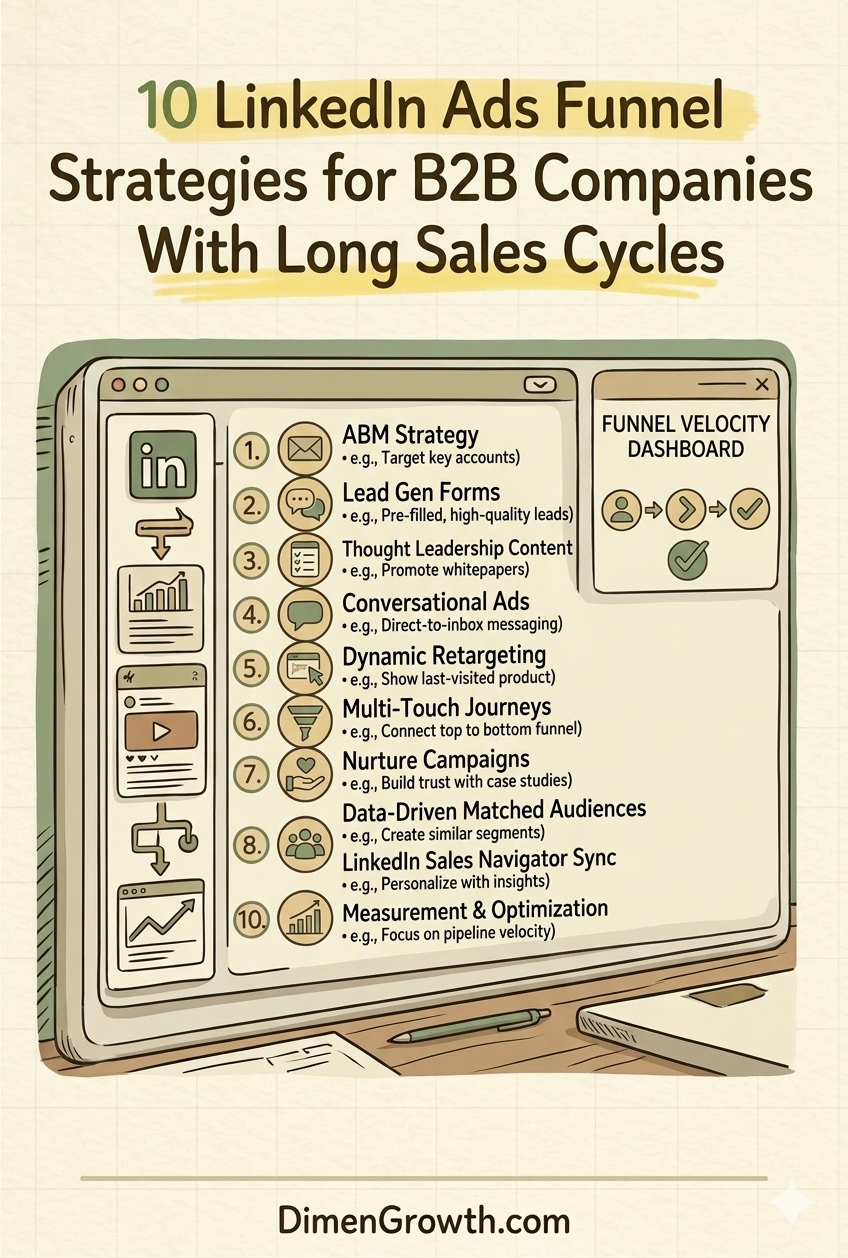
| Strategy | Funnel Stage | Primary Format | Sales Cycle Role | Time to Impact |
|---|---|---|---|---|
| 1. Authority Content Sequence | Top | Thought Leader + Document | Build brand trust over 60 to 90 days | 60 to 90 days |
| 2. Progressive Lead Capture | Top to Mid | Lead Gen Form series | Capture and qualify intent early | 30 to 60 days |
| 3. Multi-Touchpoint Retargeting | Mid | Video + Single Image | Nurture warm audiences consistently | Ongoing |
| 4. Sales-Aligned ABM Sequence | Mid to Bottom | Conversation + Carousel | Align ads to sales pipeline stages | 60 to 90 days |
| 5. Competitive Displacement Layer | Bottom | Single Image + Conversation | Convert evaluation-stage prospects | 30 to 45 days |
| 6. Re-engagement Campaign | All stages | Lead Gen Form | Revive stalled pipeline opportunities | 30 days |
| 7. Influencer and Peer Evidence | Mid to Bottom | Thought Leader + Video | Reduce risk perception in final stage | 45 to 60 days |
| 8. Event and Milestone Triggers | All stages | Varies | Activate timing-based urgency | Event-dependent |
| 9. Executive Nurture Track | Mid to Bottom | Conversation + Thought Leader | Maintain C-suite visibility in long deals | Ongoing |
| 10. Win-Back Sequence | Bottom | Lead Gen Form + Video | Recover lost or stalled opportunities | 30 to 60 days |
The 10 LinkedIn Funnel Strategies for Long Sales Cycle B2B
Strategy 1: The Authority Content Sequence
Funnel stage: Top of funnel
Primary formats: Thought Leader Ads, Document Ads
The authority content sequence runs consistently for 60 to 90 days before any conversion campaign is introduced. Its only job is to make your brand the most credible, informed voice in your category for the buyer audience you are targeting. Original research, executive thought leadership, industry predictions, and behind-the-numbers posts are the content types that build this authority at scale.
For long sales cycle B2B, brand preference is established during the evaluation period, not at the point of final decision. The company whose content a buyer has been reading and sharing for three months before a procurement process begins enters that process with an unfair advantage. This strategy builds that advantage systematically.
- Duration: Run continuously as the permanent top-of-funnel layer
- Budget allocation: 20 to 30 percent of total LinkedIn ads budget
- Success metric: Retargeting pool growth and branded search volume increase, not direct conversion
- Content cadence: Minimum two new thought leadership pieces per month
Strategy 2: Progressive Lead Capture
Funnel stage: Top to mid funnel
Primary format: Lead Gen Form Ad series with escalating offer value
Progressive lead capture treats the lead generation process as a sequence of low-commitment offers rather than a single high-commitment ask. The first offer captures a name and email with a low-barrier content download. A second, more specific offer three to four weeks later requests slightly more detail (company size, current solution, timeline). A third offer introduces a consultative element.
Each step qualifies intent progressively without overwhelming a buyer who is not yet ready for a sales conversation. By the time a prospect has engaged with three progressive offers, your sales team has high-quality intelligence about their situation and is entering the conversation with relevant context.
- Offer 1: Low barrier, broad value (industry report, checklist, framework)
- Offer 2: Moderate barrier, specific value (benchmarking tool, diagnostic, calculator)
- Offer 3: Higher barrier, high value (audit, consultation, personalised assessment)
- Timing: 21 to 28 days between each offer stage in the retargeting sequence
Strategy 3: Multi-Touchpoint Retargeting
Funnel stage: Mid funnel
Primary formats: Video Ad, Single Image Ad
Multi-touchpoint retargeting creates a continuous presence for buyers who have engaged with your brand but have not yet converted to a meaningful pipeline opportunity. The key is variation: serving the same ad repeatedly creates ad fatigue, while rotating between different formats, angles, and content types maintains relevance across a long evaluation period.
Structure your retargeting rotation across three to four different ad angles: customer proof (case study or testimonial), expert insight (data or framework), problem framing (articulating the cost of inaction), and solution demonstration (product or service in action). Rotate between these angles on a four to six week cycle to maintain engagement across the full sales cycle duration.
- Retargeting audiences: Website visitors, video viewers (25 to 50 percent completion), Lead Gen Form openers
- Creative rotation: Change the primary angle every 4 to 6 weeks
- Frequency management: Monitor and refresh creative when frequency exceeds 4 per month per audience member
- Duration: Maintain for the full estimated sales cycle length plus 30 days
Strategy 4: Sales-Aligned ABM Sequence
Funnel stage: Mid to bottom funnel
Primary formats: Conversation Ad, Carousel Ad
The sales-aligned ABM sequence coordinates LinkedIn advertising directly with your sales team’s pipeline activity. When a deal enters a new stage in your CRM, a corresponding LinkedIn campaign automatically activates to provide air cover, build stakeholder awareness, and reinforce the value proposition your sales team is delivering in person.
This requires either manual campaign management coordination between marketing and sales, or a marketing automation integration that triggers LinkedIn audience updates based on CRM stage changes. The result is that your LinkedIn ads are always contextually relevant to where each deal is in the buying process, which dramatically improves engagement and conversion rates in the final stages of a long sales cycle.
- Implementation: Tag CRM contacts by deal stage and upload to LinkedIn Matched Audiences
- Stage-specific messaging: Awareness stage ads build brand recognition; evaluation stage ads address competitive objections; decision stage ads remove final barriers
- Coordination cadence: Weekly sync between marketing and sales on active deal list and campaign status
- Best for: Companies with deal sizes above AED 150,000 where coordinated effort is commercially justified
Strategy 5: Competitive Displacement Layer
Funnel stage: Bottom of funnel
Primary formats: Single Image Ad, Conversation Ad
The competitive displacement layer activates when buyers are actively evaluating alternatives, which in a long sales cycle typically occurs 30 to 60 days before the final decision. This campaign layer serves ads that directly address the most common reasons buyers choose competitors over your solution, without naming competitors explicitly.
Effective competitive displacement ads lead with a specific differentiator and let the implication do the work. “Most agencies track impressions. We track pipeline.” “The difference between our approach and most LinkedIn ads management is that we own the outcome, not just the execution.” These frames position your solution favourably against the competitive alternatives your buyer is considering without requiring you to name anyone.
- Trigger: Activate when retargeting audience members have visited your pricing page or requested a proposal
- Content angle: Address the top 2 to 3 objections your sales team hears most frequently at the evaluation stage
- Format: Single Image Ads for broad awareness within the evaluation pool; Conversation Ads for high-priority named accounts
- Duration: Run for 45 to 60 days leading into the expected decision window
Strategy 6: Re-engagement Campaign
Funnel stage: All stages
Primary format: Lead Gen Form Ad
Long sales cycles inevitably produce stalled opportunities: prospects who engaged strongly early in the process but went quiet for 30, 60, or 90 days. Most B2B companies either continue chasing these prospects with sales outreach (which creates friction) or write them off entirely (which wastes the investment already made in engaging them).
A re-engagement campaign targets these stalled prospects through LinkedIn with a new, high-value offer that creates a fresh reason to reconnect without requiring them to resume a sales conversation they paused. A new research report, an exclusive event invitation, or a relevant industry development can reactivate dormant interest at the precise moment the buyer’s situation changes, which is typically what caused them to re-engage in the first place.
- Audience: Upload a CSV of stalled pipeline contacts to LinkedIn Matched Audiences
- Offer: New, high-value content that did not exist when the relationship went cold
- Timing: Activate 60 days after the last meaningful engagement or sales touchpoint
- Follow-up: Alert sales team immediately when a stalled contact engages with the re-engagement ad
Strategy 7: Influencer and Peer Evidence Layer
Funnel stage: Mid to bottom funnel
Primary formats: Thought Leader Ad, Video Ad
In the final stages of a long B2B sales cycle, risk reduction becomes the buyer’s primary concern. They have identified the problem, evaluated solutions, and narrowed their choice. What remains is the fear of making a wrong decision and the internal political risk of sponsoring a vendor that underdelivers.
The influencer and peer evidence layer addresses this risk directly by amplifying credible third-party voices through Thought Leader Ads and customer video testimonials. A customer with a similar profile to your prospect, speaking specifically about the risk they felt before making the decision and the outcome they experienced after, is the single most powerful conversion asset in a long sales cycle B2B campaign.
- Content type: Customer testimonials from companies with ICP-matching profiles (similar size, industry, challenge)
- Format: 60 to 90 second video testimonials promoted as Video Ads; written customer perspectives promoted as Thought Leader Ads
- Targeting: Retarget evaluation-stage prospects and named accounts in active deal stages
- Outcome: Reduces perceived risk, shortens final decision timeline, and gives buyers internal political cover
Strategy 8: Event and Milestone Trigger Campaigns
Funnel stage: All stages, context-dependent
Primary formats: Lead Gen Form, Single Image, Conversation Ad
External events create natural buying windows that long sales cycle B2B companies can activate through targeted LinkedIn campaigns. Regulatory changes, industry reports, market shifts, conference seasons, budget cycles, and quarterly business reviews all create moments when buyers are particularly receptive to relevant solutions.
Map your campaign calendar to the events and milestones most relevant to your buyers’ decision-making cycles. In the UAE, this includes the financial year end cycle (typically March or December depending on the company), major industry conferences like GITEX, and budget planning periods in Q3 and Q4. Building a campaign that activates specifically around these moments creates contextual relevance that broadly targeted campaigns cannot replicate.
- Event types: Industry conferences, regulatory changes, budget cycles, fiscal year boundaries
- Lead time: Prepare event-triggered campaigns at least 3 to 4 weeks before the trigger date
- Message angle: Connect your solution directly to the relevance of the event or milestone
- UAE-specific triggers: GITEX, Arabian Travel Market, Gulf Food, financial year end, VAT compliance periods
Strategy 9: Executive Nurture Track
Funnel stage: Mid to bottom funnel
Primary formats: Conversation Ad, Thought Leader Ad
In complex B2B deals with multiple stakeholders, the C-suite sponsor often disengages from the detailed evaluation process while remaining the final decision authority. An executive nurture track maintains LinkedIn visibility with C-level and VP stakeholders throughout the deal, even when the primary engagement has moved to mid-level evaluators.
The content for the executive track should be appropriately senior: strategic impact, competitive risk, and revenue outcome framing, not feature comparisons or implementation details. A CEO who has been seeing relevant, high-quality content from your brand consistently across a 90-day evaluation period is far more likely to approve a recommendation from their team than one who encounters your brand for the first time at the final presentation.
- Audience: Named executive contacts at active deal accounts, uploaded to LinkedIn Matched Audiences
- Content: Thought leadership from your own executives, senior customer testimonials, and strategic impact data
- Frequency: Two to three impressions per month is sufficient; more creates frequency fatigue with this audience
- Coordination: Align content themes with the key messages your sales team is delivering in active conversations
Strategy 10: Win-Back Sequence
Funnel stage: Bottom of funnel
Primary formats: Lead Gen Form, Video Ad
Closed-lost deals from long sales cycles represent some of the highest-quality prospects in your entire addressable market. These are buyers who evaluated your solution seriously, which means they have the budget, the need, and the organisational will to solve the problem. The timing was wrong, the competitor won, or the deal stalled for an internal reason that has nothing to do with the quality of your solution.
A win-back sequence targets closed-lost contacts through LinkedIn 60 to 120 days after the deal closed. By this point, the winning competitor’s honeymoon period may be ending, implementation may have encountered challenges, or the buyer’s situation may have changed. A well-timed win-back campaign with a specific new hook, a relevant data point, or a direct invitation to revisit the evaluation can reactivate high-quality opportunities that most B2B companies leave permanently dormant.
- Audience: Upload closed-lost contacts from CRM (deals closed within the last 6 to 12 months)
- Hook: A new capability, a relevant industry development, or a specific customer outcome that did not exist when the original deal closed
- Timing: Activate 60 to 90 days after close-lost date; run for 45 to 60 days
- Sales coordination: Alert sales team when a win-back contact re-engages; do not let the re-engagement die at the ad level
How to Sequence These 10 Strategies Across a Long Sales Cycle
Months 1 and 2: Foundation
Activate Strategy 1 (Authority Content Sequence) and Strategy 2 (Progressive Lead Capture) simultaneously. The first builds brand recognition with cold audiences. The second begins capturing and qualifying intent. Set up LinkedIn Insight Tag and conversion tracking. Build your initial retargeting pools.
Months 2 and 3: Nurture Layer
Add Strategy 3 (Multi-Touchpoint Retargeting) and Strategy 7 (Influencer and Peer Evidence) as retargeting audiences reach minimum thresholds (300 or more members). These campaigns maintain engagement with prospects who are actively evaluating solutions.
Months 3 to 5: Conversion and ABM
Activate Strategy 4 (Sales-Aligned ABM Sequence) for active pipeline accounts and Strategy 5 (Competitive Displacement Layer) for prospects approaching decision stage. Add Strategy 9 (Executive Nurture Track) for complex multi-stakeholder deals.
Ongoing: Re-engagement and Win-Back
Run Strategy 6 (Re-engagement Campaign) and Strategy 10 (Win-Back Sequence) continuously as stalled and lost opportunities accumulate. Activate Strategy 8 (Event and Milestone Triggers) around relevant industry moments throughout the year.
For a detailed implementation guide on building this full-funnel architecture for your specific industry and sales cycle, explore our LinkedIn Ads playbook for B2B companies with long sales cycles.
Frequently Asked Questions
How long should a LinkedIn ads funnel run for B2B companies with 90-day sales cycles?
Plan for a minimum of six months before evaluating the full-funnel ROI of your LinkedIn strategy. The first two to three months build the audience data and retargeting pools that downstream campaigns depend on. Month four to six is typically when the full-funnel begins generating pipeline at predictable CPL. Evaluating LinkedIn ROI at 30 days for a 90-day sales cycle gives you an incomplete and misleading picture.
What is the right budget split across funnel stages for long sales cycle B2B?
A balanced allocation for long sales cycle B2B LinkedIn campaigns is approximately 25 to 30 percent on top-of-funnel awareness and authority building, 40 to 45 percent on mid-funnel nurturing and retargeting, and 25 to 30 percent on bottom-funnel conversion and ABM. This shifts as campaigns mature: awareness investment can decrease as retargeting pools grow, freeing budget for higher-precision conversion campaigns.
How do I know when a LinkedIn ad prospect is ready for sales outreach?
Strong intent signals from LinkedIn advertising include: visiting the pricing page after engaging with a content ad, opening a Lead Gen Form but not completing it, watching 75 percent or more of a product demo video, and engaging with a Conversation Ad. Set up LinkedIn Insight Tag event tracking to alert your sales team when prospects from specific target accounts trigger these high-intent actions.
Can LinkedIn ads replace email nurturing for long sales cycle B2B?
LinkedIn ads and email nurturing serve complementary roles in a long sales cycle and are most effective when run in parallel. LinkedIn reaches buyers during professional consumption moments and maintains brand visibility even when prospects are not opening emails. Email nurturing delivers higher-volume touchpoints at lower cost but depends on maintaining deliverability and open rates across a long period. Use both rather than choosing between them.
How do I measure LinkedIn ROI for a B2B company with a six-month sales cycle?
Track LinkedIn-attributed pipeline value using UTM parameters on all ads combined with CRM opportunity source tracking. Measure LinkedIn’s contribution at three levels: influenced opportunities (LinkedIn touch in the 90 days before opportunity creation), sourced opportunities (LinkedIn as the first touch), and assisted closed revenue (LinkedIn touch at any point in the won deal journey). Evaluate all three metrics, not just last-touch conversion.
Build a LinkedIn Funnel That Lasts the Full Sales Cycle
The linkedin ads funnel b2b long sales cycle challenge is not a resource problem. It is a strategy problem. Most companies try to solve a 90-day buying journey with a 30-day campaign. The result is wasted budget, incomplete data, and the conclusion that LinkedIn simply does not work for their business.
These 10 strategies give you a complete architecture for maintaining LinkedIn influence across the full duration of a complex B2B sale. Start with the foundation, build the nurture layer, and activate the conversion and ABM strategies as your pipeline matures. The companies that run LinkedIn this way do not ask whether it works. They track how much pipeline it generates and optimise accordingly.
If you want a LinkedIn funnel built specifically for your sales cycle, deal size, and ICP, our B2B LinkedIn Ads team at Dimen Growth designs and manages full-funnel programs for complex B2B companies across the UAE and GCC.
Let’s build your LinkedIn pipeline engine. Book a strategy session with our LinkedIn specialists.
Related reading: LinkedIn Ads Strategy for B2B | LinkedIn Ads Agency Dubai
Sources: LinkedIn Marketing Solutions | Demand Gen Report B2B Buyer Survey