LinkedIn Thought Leader Ads are the most underinvested format in B2B advertising right now. While most companies are competing for the same Sponsored Content placements with branded company page posts, a small group of B2B marketers has quietly figured out that amplifying the right executive voice through linkedin thought leader ads b2b campaigns consistently outperforms almost every other format on the platform.
The reason is simple. People trust people more than they trust brands. When a CEO, CMO, or subject-matter expert posts a genuine perspective and that post is amplified to a precisely targeted professional audience, the trust signal is fundamentally different from anything a company page can produce. This guide breaks down 7 specific strategies for making that work at scale.
| Key Takeaways Thought Leader Ads promote individual employee posts to paid audiences, bypassing company page limitationsThe format works because it exploits the same trust signals that make organic personal content effectiveAmplifying already-performing organic posts reduces creative risk and improves paid distribution qualityContrarian takes and data-backed posts generate the highest engagement rates for B2B audiencesThe executive ABM warm-up strategy is one of the most underused high-conversion plays in B2B LinkedInRotating multiple executive voices builds category authority that no single company page campaign can match |
What Makes LinkedIn Thought Leader Ads Different From Standard Sponsored Content
Standard LinkedIn Sponsored Content is promoted from a company page. It displays the company logo, company name, and follower count. No matter how strong the creative, the audience knows they are being marketed to by a brand.
Thought Leader Ads are promoted from an individual employee’s personal post. They display the person’s profile photo, name, job title, and personal follower count. The content reads like an organic post from a real professional, because it is. The paid promotion simply extends its reach beyond the person’s existing network to a precisely targeted audience.
This distinction drives the performance difference. Engagement rates on Thought Leader Ads consistently run two to four times higher than equivalent Sponsored Content from company pages. For B2B brands where trust and credibility determine vendor selection, this is not a marginal improvement. It is a structural advantage.
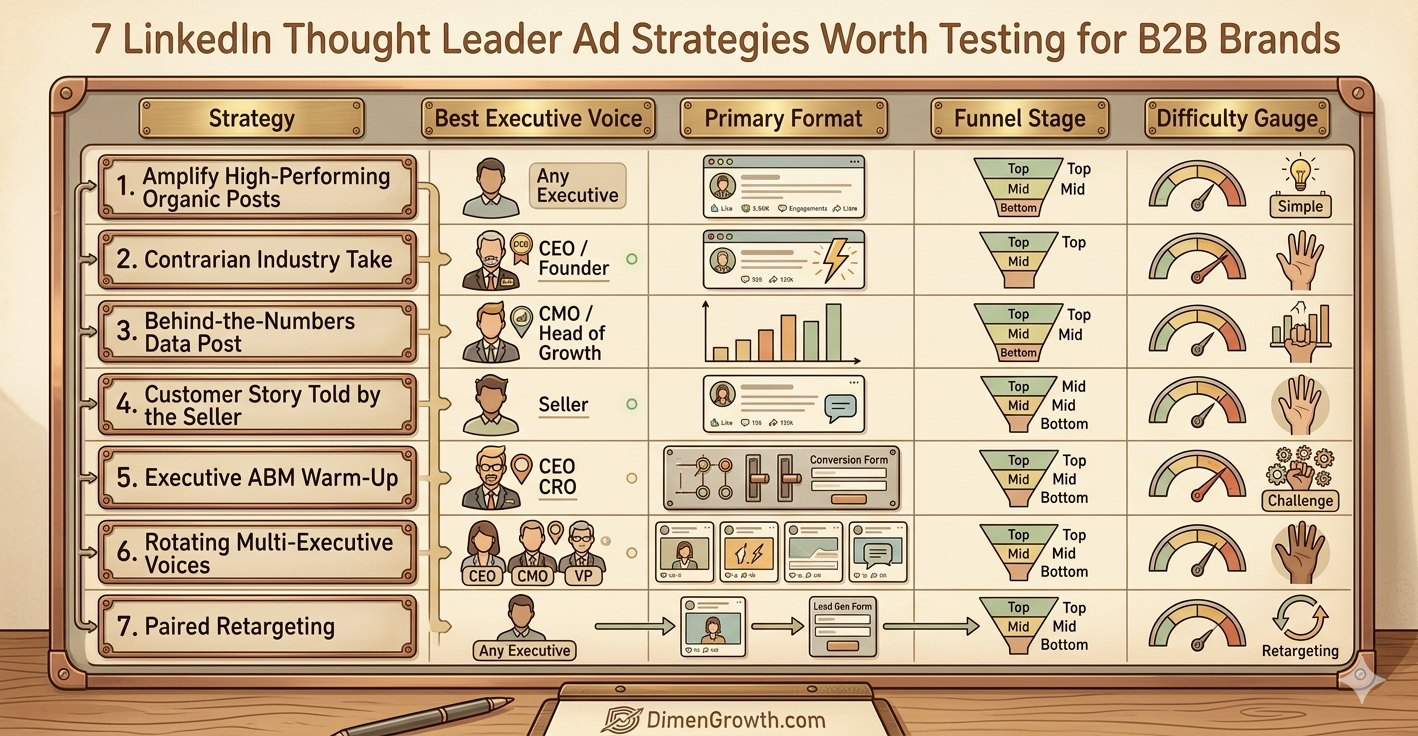
| Strategy | Best Executive Voice | Primary Format | Funnel Stage | Difficulty |
| 1. Amplify High-Performing Organic Posts | Any executive | Thought Leader Ad | Top/Mid | Low |
| 2. Contrarian Industry Take | CEO / Founder | Thought Leader Ad | Top | Medium |
| 3. Behind-the-Numbers Data Post | CMO / Head of Growth | Thought Leader Ad | Top/Mid | Medium |
| 4. Customer Story Told by the Seller | AE / CSM | Thought Leader Ad | Mid | Low |
| 5. Executive ABM Warm-Up | CEO / CRO | Thought Leader + Conversation | Mid/Bottom | High |
| 6. Rotating Multi-Executive Voices | Multiple leaders | Thought Leader Ad | Top/Mid | Medium |
| 7. Paired Retargeting Sequence | Any executive | Thought Leader + Lead Gen | Mid/Bottom | Medium |
The 7 LinkedIn Thought Leader Ad Strategies for B2B
Strategy 1: Amplify Your Best-Performing Organic Posts
Best executive voice: Any executive or senior team member with an active LinkedIn presence
Primary format: Thought Leader Ad promoting an existing organic post
The lowest-risk, highest-efficiency Thought Leader Ad strategy is the simplest one: identify the organic posts from your executives that have already demonstrated strong engagement, and amplify them with paid reach. If a post has already generated above-average likes, comments, and shares with the person’s organic audience, it contains a proven hook and message that your paid target audience is also likely to respond to.
Check your executives’ LinkedIn analytics weekly and flag posts that exceed your typical engagement benchmark by 50 percent or more. These are your amplification candidates. Run them as Thought Leader Ads targeted to your core ICP audience for two to three weeks per post.
The additional benefit of this approach is social proof compounding. When a paid audience sees a post with 80 organic likes and 30 comments, those existing reactions reinforce credibility before the viewer has read a single word. Cold audiences exposed to paid content with existing social proof engage at significantly higher rates than with zero-engagement branded content.
- Selection criteria: Posts with above-average organic engagement (50 percent or more above the executive’s typical post performance)
- Targeting: Core ICP by job function, seniority, and industry
- Duration per post: 2 to 3 weeks before rotating to the next high-performer
- Budget: Start at AED 2,000 to 3,000 per post amplification to gather meaningful performance data
Strategy 2: The Contrarian Industry Take
Best executive voice: CEO or Founder with genuine market experience and a defensible point of view
Primary format: Thought Leader Ad promoting a deliberately counter-consensus post
The most engaging Thought Leader Ad content in B2B is almost always a strong, specific opinion that challenges conventional wisdom in your industry. Not manufactured controversy. A genuine perspective, backed by real experience or data, that says something your target audience has thought but not yet heard articulated clearly.
The structure of a high-performing contrarian post follows a consistent pattern. Open with the claim that contradicts the consensus. Follow immediately with the data, experience, or observation that supports it. Close with the implication for your reader. The entire post should be readable in under 90 seconds and should end with a question or a specific takeaway that earns a response.
When this post is amplified to a cold ICP audience through a Thought Leader Ad, the contrarian hook creates pattern interruption in a feed full of agreeable, forgettable content. Engagement rates are typically two to three times higher than brand-forward posts, and the comment quality tends to attract exactly the kind of decision-makers your sales team wants to have conversations with.
- Post structure: Claim, evidence, implication, question
- Topic source: The most common piece of advice in your category that your experience contradicts
- Tone: Confident but not aggressive; the goal is to earn agreement from smart people, not to start arguments
- Follow-up: Retarget everyone who engages with a Lead Gen Form offering a deeper resource on the same theme
Strategy 3: The Behind-the-Numbers Data Post
Best executive voice: CMO, Head of Growth, or anyone with access to proprietary performance data
Primary format: Thought Leader Ad with a data-led organic post
Original data is the scarcest and most valuable resource in B2B content marketing. When your executive shares specific, verifiable numbers from your own work or research, the post occupies a category that no competitor can copy and no aggregator can replicate. It positions your brand as a primary source of truth in your industry, not a secondary commentator on what others have found.
The most effective format for a data post is to open with the specific number that surprises, follow with the context that explains why it matters, and close with the implication or recommendation your data supports. Avoid the temptation to hold back the interesting number behind a content gate. The data in the post is what earns the share and the follow. The gate comes in the retargeting campaign that follows.
Examples of data post structures that perform well for B2B Thought Leader Ads: “We reviewed 47 LinkedIn ad accounts last quarter. 38 had no retargeting active. The 9 that did averaged a CPL 54 percent lower. The gap is not subtle.” Specific, surprising, and immediately actionable for the target audience.
- Data sources: Your own client results, internal benchmarks, surveys of your customer base, or original research you have conducted
- Specificity rule: Use exact numbers, not ranges. ’38 of 47′ outperforms ‘most companies’ every time
- Cadence: One data post per executive per month is sufficient; more dilutes the impact of each
- Amplification window: Run as a Thought Leader Ad for 3 to 4 weeks; retarget engagers with a related content offer
Strategy 4: The Customer Story Told by the Seller
Best executive voice: Account Executive, Customer Success Manager, or Practice Lead who owns the customer relationship
Primary format: Thought Leader Ad promoting a first-person customer narrative post
Most B2B case studies are written in the third person and published on a company website where they are read by almost nobody. The Thought Leader Ad version of a customer story is completely different: the Account Executive or CSM who worked with the customer writes a first-person post about what the customer was experiencing, what changed, and what the outcome was. The post reads like a practitioner sharing a genuine win, not a marketing team publishing an official case study.
The first-person attribution is critical. When an AE writes “I worked with a B2B SaaS company in Dubai last quarter that was spending AED 18,000 per month on LinkedIn ads with a CPL of AED 420. We rebuilt their campaign structure in three weeks. CPL dropped to AED 180. Same budget, same audience, different architecture,” it reads as a professional observation from someone who was in the room. That trust signal is worth more than any brand-polished case study.
For B2B companies with a strong customer success function, this strategy can generate a continuous stream of Thought Leader Ad content at low production cost. The AE or CSM writes the post in their natural voice. The marketing team reviews for accuracy and compliance. The post goes live and is amplified to a new prospects audience that matches the customer profile in the story.
- Post length: 150 to 300 words. Enough to tell the before, the change, and the after. Nothing more.
- Specificity requirement: Include at least one specific number (the outcome metric that changed)
- Targeting: Match the paid audience to the customer profile in the story (same industry, company size, seniority)
- Compliance check: Confirm customer approval for any specific details shared publicly before amplifying
Strategy 5: The Executive ABM Warm-Up
Best executive voice: CEO, Founder, or CRO with direct market credibility
Primary format: Thought Leader Ad targeted to a named ABM account list, followed by a Conversation Ad
The executive ABM warm-up is one of the highest-converting plays in B2B LinkedIn advertising and one of the least commonly used. The strategy works in two stages. In stage one, a Thought Leader Ad from your CEO or most credible executive is served specifically to decision-makers at your target account list for three to four weeks. No CTA. No product mention. Just a consistently valuable, relevant post that builds recognition and credibility.
In stage two, after the target executives have seen the Thought Leader Ad content two to three times, a Conversation Ad is activated from the same executive’s personal account. The message opens with a reference that implies familiarity without being presumptuous: “I have been sharing some thoughts on [topic] recently. Given what your team is working on at [Company], I thought this specific angle might be relevant.” The conversion rate on Conversation Ads that follow a warm Thought Leader Ad sequence is dramatically higher than on cold Conversation Ad outreach.
This strategy requires coordination between marketing (managing the Thought Leader Ad targeting) and sales (using the LinkedIn activity data to prioritise outreach), but the pipeline quality it generates justifies the coordination cost for any deal size above AED 100,000.
- Stage 1 duration: 3 to 4 weeks of Thought Leader Ad impressions to the target account list
- Stage 2 trigger: Activate Conversation Ad after target accounts have received a minimum of 3 Thought Leader Ad impressions
- Account list size: Minimum 200 companies to ensure sufficient audience after matching
- Sales handoff: Alert sales team when a named account executive engages with the Thought Leader Ad content
Strategy 6: Rotating Multi-Executive Voices
Best executive voice: A team of three to five leaders across different functions: CEO, CMO, CRO, technical lead, customer success lead
Primary format: Multiple Thought Leader Ads running simultaneously from different executives
A single executive’s Thought Leader Ads build personal brand authority. A rotating group of executive voices builds something more valuable for B2B sales: multi-dimensional company credibility. When a prospect encounters your CEO discussing market strategy, your CRO sharing pipeline methodology, and your technical lead explaining implementation complexity, each from a different perspective and in a different authentic voice, the cumulative effect is an impression of an organisation filled with credible, knowledgeable people.
This strategy also solves a practical problem: any single executive can only produce a limited volume of high-quality, genuinely personal content without it starting to feel manufactured. Distributing the content responsibility across five executives, each writing one or two posts per month from their area of genuine expertise, creates a sustainable content engine that does not depend on any single person’s time or inspiration.
Run three to five Thought Leader Ads simultaneously from different executives, each targeted to a slightly different sub-segment of your ICP. Monitor engagement rates per executive to identify which voices resonate most with which audience segments, and weight your budget allocation accordingly.
- Minimum executive roster: 3 voices. Ideal: 5 to 6 covering CEO, revenue, marketing, technical, and customer success perspectives
- Content coordination: Each executive writes from their genuine area of expertise. Do not ghostwrite across functions.
- Budget split: Allocate by engagement performance. Higher-performing voices receive more amplification budget
- Review cadence: Monthly review of per-executive engagement rates and audience overlap to optimise targeting
Strategy 7: The Paired Retargeting Sequence
Best executive voice: Any executive whose Thought Leader Ads have generated significant engagement
Primary format: Thought Leader Ad followed by a retargeting Lead Gen Form Ad
The paired retargeting sequence treats Thought Leader Ads as the awareness and trust-building layer, and deploys a conversion-focused Lead Gen Form Ad specifically against the audience that has already engaged with the Thought Leader content. This is the most efficient path from cold audience to warm lead using the Thought Leader Ad format.
The sequence works because engagement with a Thought Leader Ad is a meaningful intent signal. Someone who liked, commented on, or clicked through a CEO’s post about a specific industry challenge is demonstrably more interested in that topic than someone who saw a branded banner ad. Retargeting that engaged audience with a directly relevant Lead Gen Form offer, within seven to fourteen days of the original engagement, converts at significantly higher rates than standard retargeting sequences.
Build retargeting audiences from Thought Leader Ad video viewers, post engagers, and profile visitors generated through the amplified post. Serve these audiences a Lead Gen Form Ad offering a resource that extends the conversation started in the original post. The continuity between the Thought Leader Ad content and the retargeting offer is what drives conversion quality.
- Retargeting audience: Engagers with the Thought Leader Ad post (likes, comments, shares, link clicks)
- Offer alignment: The Lead Gen Form offer should extend the theme of the original Thought Leader post
- Timing: Activate the retargeting campaign within 7 to 14 days of the original Thought Leader Ad engagement
- CPL benchmark: Well-executed paired sequences typically deliver CPLs 35 to 50 percent below cold Lead Gen Form campaigns
How to Get Executives to Participate in Thought Leader Ad Campaigns
The most common barrier to Thought Leader Ads is not strategic or technical. It is internal. Getting busy executives to write genuine, personal LinkedIn content on a consistent basis requires a clear value proposition for the executive, a low-friction content creation process, and visible results that make the investment feel worthwhile.
Make the Value Personal, Not Just Corporate
Executives invest in Thought Leader Ad participation when they understand that the content builds their personal brand, not just the company’s pipeline. Frame the value as: “Every post we amplify increases your personal reach, grows your following, and positions you as the leading voice on this topic in your industry.” Pipeline benefit for the company is secondary to the personal credibility benefit for the individual.
Reduce the Production Barrier
Do not ask executives to write polished marketing copy. Ask them to share a genuine perspective, a surprising number, or a specific observation from their work. The marketing team’s role is to help structure that raw material into a post format that performs well on LinkedIn, not to replace their authentic voice with corporate language. A 15-minute conversation between a content writer and an executive can produce enough material for two to three high-quality posts.
Show Results Consistently
Share engagement data, retargeting audience growth, and pipeline attribution from Thought Leader Ad campaigns with participating executives on a monthly basis. When a CEO can see that their last post reached 12,000 targeted professionals, generated 340 engagements, and contributed to 8 new pipeline opportunities, the internal business case for continued participation is self-evident.
For help building a Thought Leader Ad programme for your B2B brand, explore our LinkedIn Ads services designed for B2B companies focused on pipeline and category authority.
Frequently Asked Questions
What is a LinkedIn Thought Leader Ad and how is it different from Sponsored Content?
A LinkedIn Thought Leader Ad promotes an individual employee’s organic post to a paid target audience, displaying the person’s name, photo, and title rather than the company logo. Standard Sponsored Content is promoted from a company page. The personal attribution creates a fundamentally different trust signal, which is why Thought Leader Ads consistently generate two to four times higher engagement rates than equivalent company-branded content.
Who in a B2B company should be the face of Thought Leader Ads?
The most effective Thought Leader Ad voices are executives with genuine subject-matter expertise and an authentic personal voice: typically the CEO, CMO, CRO, or a recognised technical or practice lead. The critical requirement is that the content must sound genuinely personal. If an executive’s LinkedIn posts read like press releases, Thought Leader Ad amplification will not rescue the performance.
How much do LinkedIn Thought Leader Ads cost for B2B companies?
Thought Leader Ads operate on the same CPM and CPC auction as standard LinkedIn Sponsored Content. CPMs typically range from AED 120 to AED 280 depending on audience targeting, industry, and competition. The effective cost is often lower than standard Sponsored Content because higher engagement rates reduce your cost per engagement over time as LinkedIn’s algorithm rewards high-quality content with better distribution.
Can you run Thought Leader Ads without the executive knowing?
No. LinkedIn requires the employee whose post is being promoted to approve the Thought Leader Ad before it goes live. The executive must have an active LinkedIn account, and they must grant the company’s Campaign Manager access to promote their posts. This approval requirement is also a useful forcing function for the internal conversation about why the strategy matters and what it will produce for the executive personally.
How do you measure the ROI of LinkedIn Thought Leader Ads for B2B?
Measure Thought Leader Ad ROI at three levels: engagement rate and cost per engagement compared to standard Sponsored Content benchmarks; retargeting audience growth generated by post engagers; and pipeline contribution tracked through LinkedIn Insight Tag and CRM attribution. The full value of Thought Leader Ads includes both direct conversion metrics and longer-term brand preference effects that show up in shortened sales cycles and improved win rates.
Start Testing Thought Leader Ads This Quarter
The linkedin thought leader ads b2b opportunity is significant precisely because most brands are still ignoring it. While your competitors compete for the same Sponsored Content placements with company-branded posts, a well-executed Thought Leader Ad programme builds the kind of personal credibility and audience trust that no amount of branded advertising budget can replicate.
Start with Strategy 1: identify your three best-performing executive posts from the last 90 days and amplify them. The test costs less than a typical Sponsored Content campaign and will give you the performance data to make the case for the full programme internally.
If you want expert help building and running a LinkedIn Thought Leader Ad strategy for your B2B brand, our LinkedIn Ads team at Dimen Growth works with B2B companies across the UAE and globally to build executive-led pipeline programmes.
Ready to make your executives your best-performing marketing channel? Talk to our LinkedIn specialists today.
Related reading: LinkedIn Ads Strategy for B2B | LinkedIn Ads Agency Dubai
Sources: LinkedIn Marketing Solutions | LinkedIn Thought Leader Ads Help Centre